
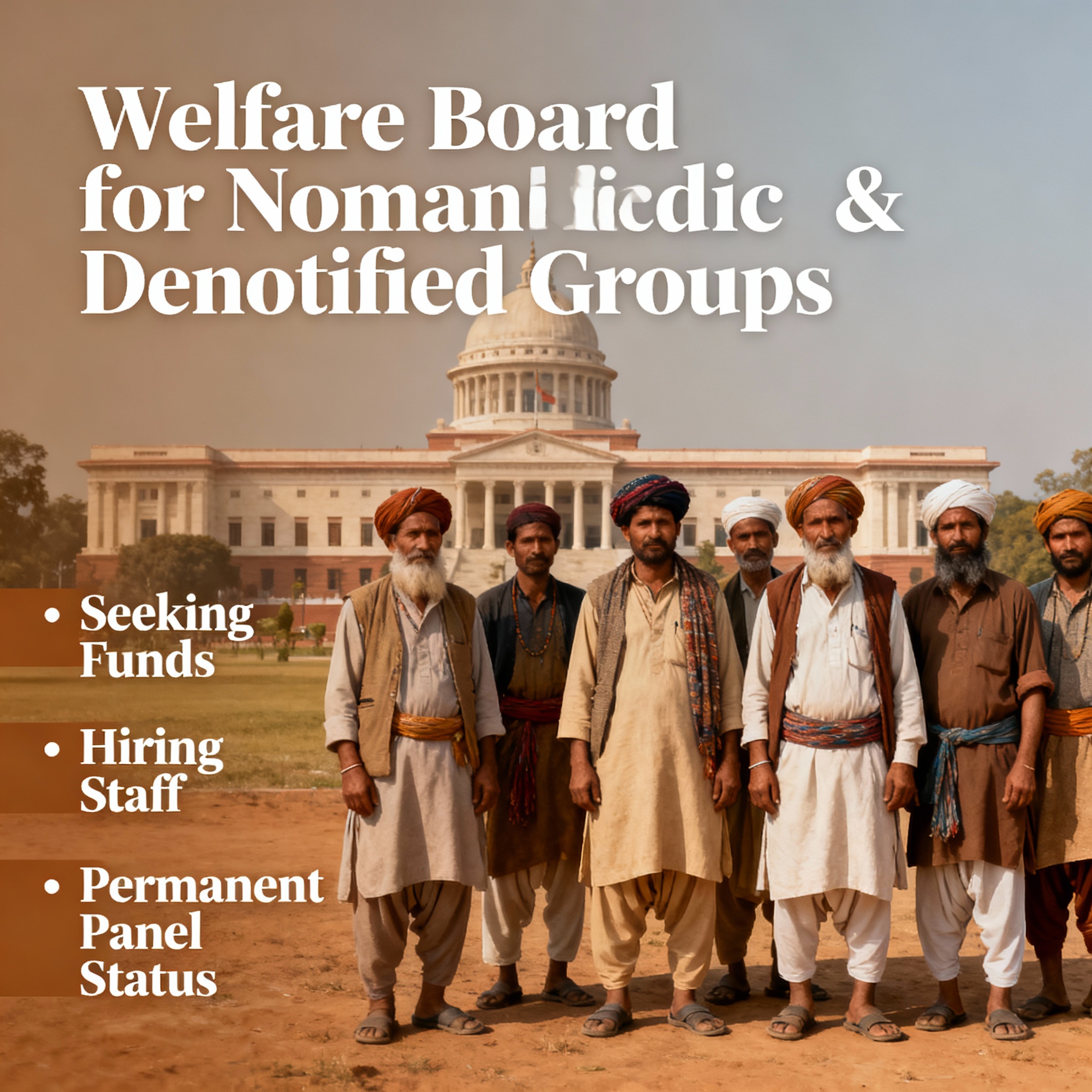
1. Welfare board for nomadic, denotified groups seeks funds, staff, permanent panel status
General Studies (GS) Paper I: Topic: Indian Society (specifically issues related to marginalized and vulnerable sections of society, including denotified, nomadic, and semi-nomadic tribes)
Context: The Development and Welfare Board for De-notified, Wandering and Nomadic Communities (DWBDNC) has reported serious operational challenges to the Prime Minister after more than five years of its formation.
- The Board, created for the welfare of nomadic and denotified groups, lacks adequate resources and staff, hampering its ability to function effectively.
- BJP leaders linked to the Prime Minister’s Office have urged immediate government action to recognize and support these marginalized communities.
Who Are These Groups?
- Denotified, Nomadic, and Semi-Nomadic Tribes (DNTs, NTs, SNTs) were historically labeled as “criminal tribes” during colonial times but were denotified after independence in 1952.
- These communities are mostly landless, migrate for livelihoods such as animal herding and artisanal work, and face significant barriers in accessing education, healthcare, and social welfare.
- Approximately 1,200 such communities were identified in a 2017 government commission, spread across Scheduled Castes, Scheduled Tribes, Other Backward Classes, and General categories, with many still unrecognized or underserved.
- The 2008 National Commission’s report led to the creation of the DWBDNC in 2019 to prioritize these “most deprived citizens.”
The DWBDNC Board: Structure and Purpose
- Established in 2019 under the Ministry of Social Justice and Empowerment, DWBDNC is tasked with policy formulation, scheme recommendation, and welfare monitoring for DNT, NT, and SNT groups.
- The Board is chaired by the Social Justice Secretary but currently has only two nominated members, lacks a dedicated office or website, and lacks functional autonomy.
- Operational effectiveness is hindered due to overlaps with other commissions for SC, ST, and OBC communities.
Demands by DWBDNC Members
- Allocation of dedicated funds and appointment of staff including Deputy Secretaries and Undersecretaries to make the Board functional.
- Elevation to a permanent, statutory body with independent financial authority and a dedicated secretariat.
- Funding for extensive surveys and official gazette notifications to formally recognize all eligible communities.
- Modifications to key schemes like SEED to address the specific needs relating to livelihood, mobility, and education of the communities.
- Administrative support to resolve procedural issues including obtaining party IDs and ensuring parity for Board members.
Key Issues Highlighted
Lack of Data
- There is a severe shortage of reliable, region-specific, and comprehensive data on DNTs, NTs, and SNTs.
- This data gap obstructs effective policy formulation and impedes implementation of the 2008 National Commission’s recommendations.
Problems with SEED Scheme 2021
- The Socio-Economic and Educational Development Scheme (SEED) operates in limited states.
- The scheme lacks adaptations for nomadic lifestyles and landlessness, resulting in limited coverage and overlap with other schemes.
Community Certificate Issues
- Many communities are not yet listed in official categories, delaying their access to reservations, scholarships, and welfare benefits.
- Partial or inconsistent recognition worsens inequalities in educational and employment opportunities.
Why a Permanent Commission is Demanded
- To resolve administrative and jurisdictional overlaps, ensuring the Board functions without dependency on temporary nominees.
- To provide the Board with its own office, leadership, financial power, and direct access to top policy forums like the PMO.
- To ensure administrative parity and clear representation of DNT/NT/SNT communities.
- To institutionalize continuous research, data collection, and reforms for sustainable welfare, benefiting over 1,200 underserved communities.
Conclusion: The DWBDNC’s letter underscores a decade of neglect for India’s nomadic and denotified tribes, who remain invisible in policy despite colonial-era injustices. Demanding permanence, funds, and data-driven action could finally integrate these 10-15% of the population into mainstream welfare, fostering equity. Urgent government response is crucial to honor 2008 commitments and prevent further marginalization, potentially setting a precedent for inclusive development.
2. CAG to launch AI system for auditing and efficiency
GS II (Governance) and GS III (Science and Technology)
CONTEXT: The Comptroller and Auditor-General (CAG) of India is developing an Artificial Intelligence (AI)-powered Large Language Model (LLM) for auditing.
- First version expected by November 2025 to improve audit efficiency, accuracy, and consistency.
- Alongside, the CAG is launching the ‘Connect Portal’ to facilitate digital communication between audit entities and auditors.
Background and Role of CAG
- CAG is a constitutional authority mandated to audit government accounts and expenditures to ensure transparency and accountability.
- Audits include Central and State governments, government agencies, public sector undertakings, and projects funded by public money.
- CAG ensures public funds are used efficiently and lawfully, providing independent assurance to the legislature and public.
Why LLM for CAG
- To leverage decades of historical audit data and institutional knowledge for improved audit analysis.
- To assist auditors in examining large data sets faster and more accurately using AI and natural language processing.
- To enhance consistency in audit results and speed up report generation.
- To identify patterns, risks, and anomalies more effectively for comprehensive insights.
Features of CAG’s LLM
- Trained on past inspection reports and audit documentation.
- Capable of processing and analyzing both structured and unstructured data.
- Supports automated generation of inspection and audit reports.
- Facilitates risk-based audit planning and in-depth data analysis.
Remote and Hybrid Auditing
- Digitization initiatives enable audits to be conducted remotely or via hybrid methods (combining online and in-person auditing).
- Allows real-time access to government databases like e-Procurement, IFMS, and sectoral systems.
- Increases audit coverage while reducing time spent on site visits.
- Examples include concurrent GST audits conducted centrally and at the states using standardized audit tools.
Connect Portal
- A unified digital platform connecting nearly 10 lakh audit entities with CAG’s offices.
- Enables auditees to respond directly to audit queries and observations online.
- Improves transparency and speeds resolution of audit issues.
- Makes audit communications technology-driven and accessible regardless of location.
Significance
- Represents a major digital transformation in public sector auditing in India.
- Improves quality, efficiency, and transparency of audits.
- Enhances accountability in management of public resources.
- Empowers auditors with modern AI tools for smarter decision-making.
Conclusion: The CAG’s AI-powered LLM, remote/hybrid auditing models, and Connect Portal mark a significant leap towards technology-driven governance. These innovations will drive faster, more accurate, and transparent audits, strengthening public trust in the use of government funds.
3. How does SC’s order affect Waqf law?
General Studies Paper II — Governance and PolityTopic:Constitutional Provisions relating to Minority Rights (Articles 25, 26, 30), Religious Endowments and Institutions,State and Community Relations,Legislative reforms and Judicial scrutiny of laws affecting minorities
Context: The Supreme Court declined to suspend the entire Waqf (Amendment) Act, 2025, but stayed key contentious provisions.
- The Act faced challenges alleging infringement of Muslim community’s rights to manage religious affairs under Article 26 and 30 of the Constitution.
What Did the Challenge Entail?
- Petitioners argued that empowering District Collectors to decide Waqf property ownership breaches legal limits, as civil courts should decide such disputes.
- The requirement that only Muslims practising Islam for at least 5 years could create Waqf was called arbitrary and restrictive.
- Inclusion of non-Muslims on Waqf Boards was seen as violating minority rights to manage religious institutions.
Provisions Stayed by the Court
- Section 3C was stayed, stopping District Collectors from unilaterally deciding if a property is government land or Waqf.
- The clause divesting properties of Waqf status automatically on inquiry commencement was deemed arbitrary and stayed.
- The 5-year practising Islam clause is stayed till rules for verification are framed.
- Caps imposed on non-Muslim members: max 4 for the Central Waqf Council and 3 for State Waqf Boards.
What are Provisions Continuing to Operate?
- Removal of “Waqf by user” doctrine, preventing misuse of government land claims.
- Mandatory registration of Waqf properties on a central digital portal for transparency.
- Application of the Limitation Act to Waqf property recovery claims, removing earlier exemptions.
What are Implications?
- The court balanced reform goals with minority protections via interim directions.
- Executive officers cannot decide title disputes, preserving separation of powers.
- The 5-year practising Islam requirement is on hold to prevent arbitrary application.
- The order preserves transparency and aims to reduce misuse of Waqf properties while respecting constitutional rights.
Conclusion: The Supreme Court’s interim order on the Waqf (Amendment) Act reflects judicial prudence by upholding key reforms but safeguarding minority rights and property interests. Final verdicts will determine the fate of the contentious provisions, balancing governance reform with constitutional freedoms.
4. Top court seeks CBI probe into tiger poaching ring
General Studies Paper III (Environment and Ecology): Topic: Wildlife Conservation, Biodiversity, and Environmental Protection, specifically tiger conservation efforts, poaching menace, and related laws like the Wildlife (Protection) Act, 1972.
General Studies Paper II (Governance and Polity) regarding judicial activism, enforcement of environmental laws, and institutional frameworks such as the National Tiger Conservation Authority and Wildlife Crime Control Bureau.
Context: The Supreme Court has directed the Union government, CBI, and Maharashtra state to respond on the existence of a well-organized transnational tiger poaching syndicate threatening tiger populations in Maharashtra and Madhya Pradesh.
- This follows a writ petition highlighting the Special Investigation Team (SIT) report uncovering a large poaching and illegal wildlife trade network.
- The court also issued notice to the National Tiger Conservation Authority (NTCA) to address the issue.
Background
- The petition by advocate Gaurav Kumar Bansal drew attention to rampant tiger poaching and trafficking uncovered by Maharashtra’s SIT.
- The syndicate not only operates across Indian states but also has international links with Southeast Asian countries, including Myanmar.
India Tiger Context
- India is home to over 70% of the world’s wild tiger population.
- Maharashtra and Madhya Pradesh contain critical tiger reserves and corridors, including protected areas like Tadoba-Andhari and Pench Tiger Reserves.
- About 30% of tigers live outside protected reserves, making them especially vulnerable to poaching.
Poaching Syndicate & Illegal Trade
- The syndicate involves a well-organized network of poachers, smugglers, hawala operators, and traffickers.
- Tiger body parts such as skins, bones, and trophies are illegally trafficked domestically and internationally, often ending in Southeast Asian markets.
- Illegal products like ‘bone glue,’ prized in traditional remedies, are produced from tiger bones.
- The arrest of people from tribal hunting communities and foreign nationals from Myanmar has revealed the syndicate’s vast reach and modus operandi.
Legal & Institutional Framework
- The Wildlife (Protection) Act, 1972, prohibits poaching and trade of wildlife, including tigers.
- The Wildlife Crime Control Bureau (WCCB) issued a “red alert” urging intensified protection and patrolling in tiger reserves.
- The National Tiger Conservation Authority (NTCA) is the apex body for tiger conservation and management in India.
Why Supreme Court Involved?
- The case involves interstate and international elements beyond the jurisdiction of any single state authority.
- The large financial trail involving hawala operations poses challenges to enforcement agencies.
- The court’s intervention aims to ensure an impartial, thorough investigation by the CBI.
- The court emphasizes the environmental, national security, and international treaty implications of the poaching racket.
Significance
- The ruling underscores the critical threat that tiger poaching poses to India’s biodiversity and wildlife conservation efforts.
- It highlights the nexus between wildlife crime and broader criminal activities such as smuggling and money laundering.
- The court’s push for a CBI probe signals a need for stronger enforcement and coordinated action at the national and international levels.
Conclusion
- India’s tiger population, a national treasure, faces a grave threat from sophisticated poaching and trafficking syndicates.
- Effective judicial oversight and central investigative efforts are essential to dismantle these networks.
- Strengthened legal, institutional, and enforcement mechanisms, with international cooperation, are key to tiger conservation and ecological balance.
5. A little-known resistance in Malabar region during the run-up to Independence
History (General Studies Paper 1): Topic: Indian National Movement — Important Uprisings and Revolts
CONTEXT: The Malabar Revolt, also known as the Moplah or Mappila Rebellion, was a significant uprising in Kerala’s Malabar region that combined anti-colonial struggle, agrarian unrest, and communal tensions.
What Was the Malabar Revolt?
- A major 1921 rebellion against British colonial rule and oppressive landlords in Malabar, Kerala.
- Involved mainly Moplah Muslim tenant farmers protesting high rents and insecure land tenure.
Causes
- Exploitative tenancy system with high rents and arbitrary evictions by Hindu landlords (Jenmis).
- Historical smaller Moplah uprisings in the 19th century showcased ongoing discontent.
- Immediate trigger: British attempts to arrest Khilafat leaders during the Khilafat and Non-Cooperation movements.
Nature and Character
- A mix of anti-British resistance, peasant agitation, and communal violence.
- The revolt began on August 20, 1921, with attacks on police and landlords’ properties.
Key Leaders
- Variyamkunnath Kunjahammed Haji: Set up a parallel Khilafat government in Nilambur.
- Ali Musaliar: Spiritual leader, executed by the British.
- Sayyid Alavi Tangal: Provided religious inspiration for the resistance.
Consequences
- Rebels established temporary parallel administration in some areas.
- Thousands of rebels were killed, imprisoned, or went missing.
- Widespread communal violence targeted Hindu communities, with destruction of temples and homes.
- “Wagon Tragedy” in November 1921 saw 67 condemned prisoners suffocate in a railway wagon.
- Massive displacement and social disruption across the region.
Historical and Political Impact
- Initially supported by Indian National Congress for anti-colonial efforts but later withdrawn due to communal excesses.
- Interpretations vary: some see it as peasant revolt, others as anti-landlord or communal conflict.
- Recent studies position it within the broader Khilafat movement efforts, with some Hindu-Muslim unity before violence escalated.
- Kerala government honors many rebels as freedom fighters amidst ongoing debates on classification.
6. First round of FTA talks with Russia bloc EAEU likely in November
General Studies Paper III (Economy) : Topic: International Trade and Trade Agreements
CONTEXT: The upcoming FTA talks with the EAEU form part of India’s broader strategy to deepen trade ties with regional economic blocs.
- This development follows recent diplomatic engagements and is set against global trade uncertainties including US tariff threats.
- The meetings between Indian Commerce Minister Piyush Goyal and EAEU’s Trade Minister Andrey Slepnev signal growing momentum towards formal trade agreements.
Objectives of India-EAEU FTA
- Enhance trade and investment between India and the EAEU member states: Armenia, Belarus, Kazakhstan, Kyrgyzstan, and Russia.
- Provide Indian exporters access to a market with a combined GDP of around $6.5 trillion.
- Boost diversification of Indian exports and reduce dependence on traditional markets.
- Improve competitiveness of Indian MSMEs in EAEU markets.
- Establish a framework for tariff reductions, trade facilitation, and mutual economic cooperation.
- Promote collaboration in technological, industrial, and infrastructure development.
Governance of EAEU
- The EAEU is an international economic union established by treaty in 2015.
- It has a supranational regulatory body called the Eurasian Economic Commission (EEC) headquartered in Moscow.
- EEC oversees customs policies, internal market regulations, and economic integration.
- Coordination with member states ensures harmonized policies and dispute resolution within the union.
Comparison with European Union (EU)
| Aspect | Eurasian Economic Union (EAEU) | European Union (EU) |
| Member Nations | Armenia, Belarus, Kazakhstan, Kyrgyzstan, Russia | 27 European countries |
| Established | 2015 | 1993 (Maastricht Treaty) |
| Combined GDP | ~$6.5 trillion | Over $17 trillion |
| Governance Body | Eurasian Economic Commission (Moscow) | European Commission (Brussels) |
| Economic Integration | Goods, services, capital, and labor mobility | Goods, services, capital, and labor mobility |
| Market Nature | Mixed economies with varying levels of market reforms | Primarily market economies |
| Trade Challenges | Sanctions and geopolitical tensions | Regulatory complexity but high standards |
| Customs Union | Yes | Yes |
Additional POINTS
|
Conclusion: The anticipated India-EAEU FTA talks demonstrate India’s strategic drive to engage emerging regional economies and diversify its trade portfolio. The agreement is expected to unlock significant trade and investment opportunities, strengthen economic ties, and support India’s broader goals of economic resilience and global integration amidst dynamic geopolitical circumstances.
7. Swachhata Hi Seva 2025
CONTEXT: The Department of Justice is observing the Swachhata Hi Seva 2025 campaign from September 17 to October 2 under the theme “Swachhotsav.”
- The campaign aligns with the festive spirit and promotes cleanliness drives and volunteerism across the country.
What is Swachhata Hi Seva 2025?
- A fortnight-long cleanliness campaign across India to strengthen volunteer-led activities for sanitation and hygiene.
- This year’s theme “Swachhotsav” combines cleanliness with celebration, encouraging eco-friendly, zero-waste festivities.
Key Activities Planned by Department of Justice
- Daily cleaning of offices, public spaces, corridors, canteens, and washrooms.
- Tree plantation and cleanliness drive in and around Jaisalmer House, New Delhi.
- Distribution of Swachhata kits and incentives to housekeeping staff for their welfare.
- “Shramdaan” (voluntary labor) events involving deep cleaning, unclogging sewerage, painting, repairing, and organizing records.
- Advocacy sessions on Reduce, Reuse, Recycle principles.
- Participation in the nationwide “Ek Din, Ek Ghanta Ek Saath” one-hour shramdaan event on September 25, 2025.
- Oath ceremony to promote commitment towards cleanliness.
This campaign exemplifies India’s commitment to keeping public spaces clean through collective action, volunteerism, and sustainable practices during festive seasons.
8. India’s National Policy on Geothermal Energy, 2025
Why in News?
- The Ministry of New and Renewable Energy (MNRE) launched India’s first National Policy on Geothermal Energy in September 2025.
- This is part of India’s bigger goal to achieve Net Zero emissions by 2070 and boost renewable energy sources.
What is Geothermal Energy?
- It is heat stored beneath the Earth’s surface.
- The energy can be used for electricity, heating, cooling, agriculture, aquaculture, and spa tourism.
- Offers continuous, reliable power unlike intermittent solar or wind.
Key Highlights of the Policy
- Scope: Applies to power generation and direct use like heating, agriculture, and cooling.
- Implementation: MNRE leads with other ministries, states, companies, and academia involved.
- Financial Support: Includes tax benefits, grants, concessional loans, and Viability Gap Funding (₹36 crore per MW).
- Regulatory Support: Open access waivers, must-run status, and parity with other renewable energy sources.
- Repurposing Wells: Focus on reusing abandoned oil and gas wells for geothermal projects in collaboration with ONGC, Vedanta, Reliance.
- Global Collaboration: Partnerships with countries like Iceland, Norway, USA, and Indonesia for research and development.
- Pilot Projects: Five approved projects for resource assessment and demonstration across India.
Geothermal Energy Scenario in India
- Potential: Estimated capacity is 10.6 GW (10,600 MW) by the Geological Survey of India (GSI).
- Hot Springs: Over 381 hot springs mapped, temperatures between 35°C to 89°C.
- Global Context: India, US, and China hold 75% of global potential for next-generation geothermal energy.
- Ongoing Projects: Pilot projects at Puga and Chhumathang (Ladakh), Cambay (Gujarat), Barmer (Rajasthan), and a 20 KW pilot plant in Telangana.
Major Geothermal Sites in India
| Region/State | Site/Key Features |
| Ladakh | Puga, Chhumathang—high-temperature springs, pilots underway |
| Himachal Pradesh | Manikaran, Satluj, Beas, Spiti Valleys—good potential for power and tourism |
| Uttarakhand | Tapoban, Alaknanda Valley—pilot and research areas |
| Gujarat | Cambay Graben—oil wells repurposing projects |
| Chhattisgarh | Tattapani field—direct heat use suitability |
| Jharkhand/West Bengal | Damodar Valley, Surajkund springs—high temperature zones |
| Andaman & Nicobar | Volcanic geothermal fields—high promise, reduce island power costs |
| Telangana | Manuguru—20 kW pilot binary-cycle plant |
| Other States | Madhya Pradesh, Odisha, Maharashtra, Meghalaya—small clusters |
Future Roadmap
- 10 GW geothermal capacity targeted by 2030.
- Around 100 GW potential expected by 2045.
- Vision for hybrid solar-geothermal projects and heating for cold regions like Ladakh, Northeast, and Andamans by 2047.