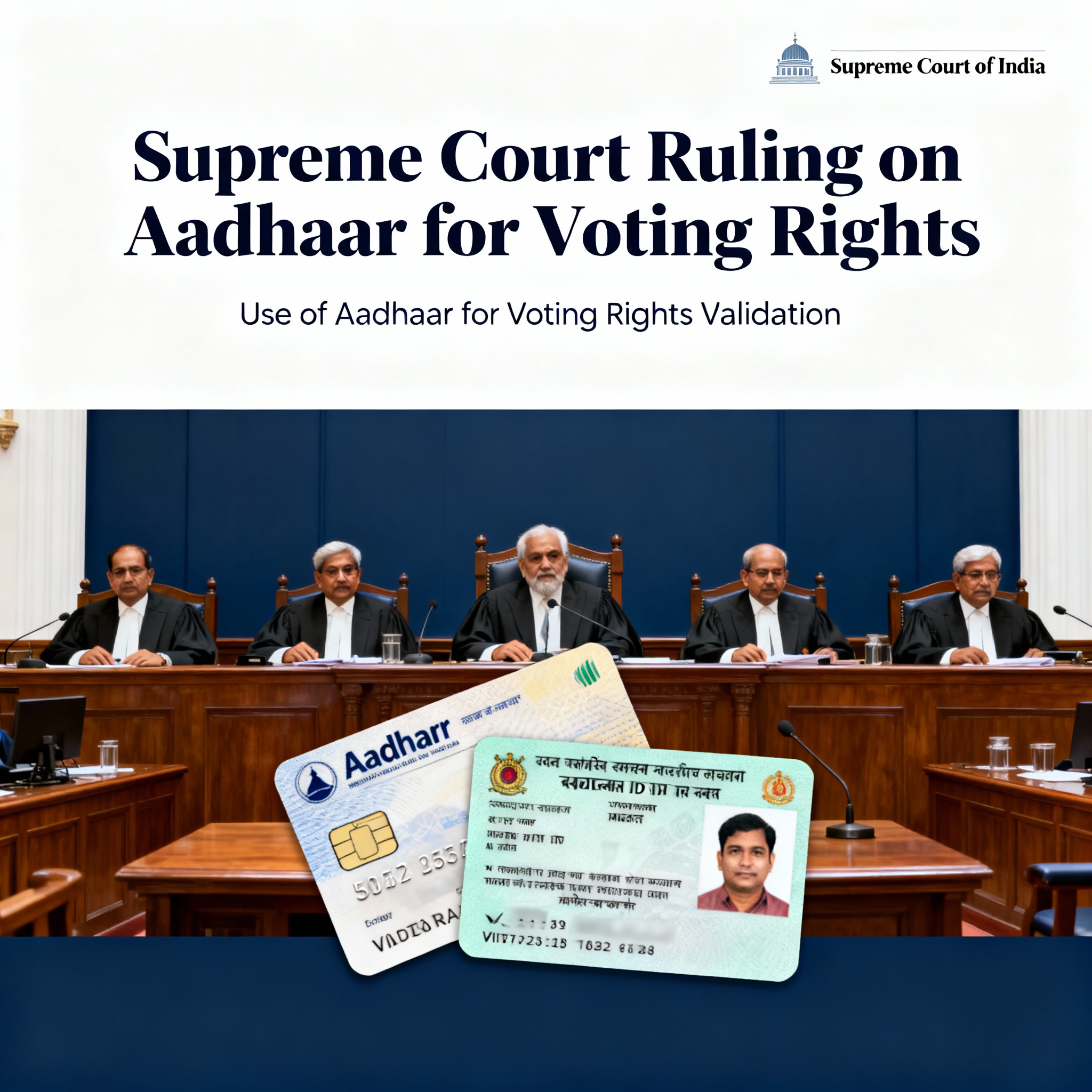
1. Aadhaar is part of statute, can be used by voters, says SC
(General Studies Paper II): Polity and Governance
Context: The Supreme Court affirmed that Aadhaar can be used as the 12th identity document for voters during Bihar’s special revision of electoral rolls.
- This decision follows ongoing legal challenges regarding Aadhaar’s appropriateness as ID proof in the electoral process.
Background
- The Election Commission traditionally allowed 11 documents for voter verification; Aadhaar’s addition as the 12th document was approved amid concerns about exclusion and procedural irregularities.
- Section 23(4) of the Representation of the People Act, 1950 provides the statutory basis for using Aadhaar for voter roll authentication, but it does not grant Aadhaar the status of proof of citizenship or domicile.
Petitioner’s Arguments (Ashwini Kumar Upadhyay)
- Argued that Aadhaar is only a “simple proof of identity”—not evidence of age, citizenship, residence, or domicile.
- Stated that anyone, not just citizens, could obtain Aadhaar, risking the enrollment of non-citizens on electoral rolls.
- Sought review of the Court’s previous order to avoid placing Aadhaar on par with other, more stringent documents like land records and passports.
Supreme Court’s Observations
- Confirmed that Aadhaar is statutorily recognized for voter roll purposes under the Representation of the People Act, 1950.
- Reiterated that Aadhaar’s role is only to prove identity—not citizenship, residence, or age.
- Observed that forgery risks apply to multiple documents, not Aadhaar alone, and asked whether land records are truly more reliable for identity than Aadhaar.
- Clarified that current permissions for Aadhaar’s use are interim and subject to further review at the October 7 hearing.
Other Lawyers’ Concerns
- Raised the issue that Booth Level Officers are not empowered to determine questions of citizenship and exclusion solely based on Aadhaar.
- Highlighted potential for exclusion errors and privacy risks involved in making Aadhaar a standard ID for voter roll operations.
- Stressed that any new voter verification process must strictly follow statutory requirements and not compromise the rights of genuine voters.
2. Court’s nod to mental health as right
General Studies II: Polity and Governance: Rights Issues, Fundamental Rights, Article 21
CONTEXT: The Supreme Court’s verdict is a constitutional landmark that elevates mental health to a fundamental right under Article 21 of the Constitution of India.
- The case arose from a father’s plea after the suspicious death of his 17-year-old NEET aspirant daughter, and the court shifted investigation to CBI due to procedural lapses.
- It addresses the larger social crisis of rampant student suicides exacerbated by systemic neglect and exploitative educational environments
Why is the Judgment in the News?
- Recognizes mental health as an integral, enforceable part of the right to life, not just a statutory protection under the Mental Healthcare Act 2017.
- Introduces the “Saha Guidelines” imposing binding interim directions on educational institutions and the government to proactively protect student mental health.
- Highlights institutional accountability, shifting the discourse from individual tragedies to systemic injustice and structural victimisation.
How Does the Case Highlight Structural Victimisation?
- Frames student suicides as outcomes of institutional failures and societal neglect rather than isolated psychological issues.
- Shows that schools, coaching centers, and hostels, combined with governmental apathy, create environments that drive students to harm.
- Positions the state and institutions as indirect perpetrators of harm through neglect, extending victimology to state responsibility.
Why Does the Verdict Matter Legally?
- Elevates mental health to a fundamental constitutional right under Article 21, demanding enforceable protections from the State and institutions.
- Fills gaps in the enforcement of the Mental Healthcare Act 2017, providing a stronger legal basis and normative benchmark.
- The “Saha Guidelines” have legislative force until replaced by Parliamentary legislation, making them immediately binding.
What are the “Saha Guidelines”?
- Mandate educational institutions—schools, colleges, hostels, coaching centers—to establish mental health support systems.
- Require appointment of qualified counsellors, mental health awareness programs, and safe reporting mechanisms.
- Prohibit harmful practices such as batch segmentation by marks, public humiliation, and unrealistic academic targets.
- Oblige States and Union Territories to enforce rules within two months and set up district-level monitoring committees.
- Guidelines hold legal authority until superseded by formal legislation.
Can Student Suicides be Seen as Structural Violence?
- Yes, invoking Johan Galtung’s theory of structural violence, which holds societal structures causing systemic harm as culpable as direct violence.
- Viewing student suicides through this lens reframes them as systemic injustices requiring state accountability rather than individual failings.
What are the Challenges in Implementation?
- Institutional inertia and cultural stigma around mental health may hinder meaningful reforms.
- Lack of trained mental health professionals and resources in educational institutions.
- Ensuring political will, continuous monitoring, and sustained investment are critical to success.
Conclusion: The Sukdeb Saha verdict is a watershed moment affirming mental health as part of the right to life and holding the state and institutions accountable.
It challenges societal and institutional complacency towards student mental health and sets binding interim legal standards.The real test lies in translating judicial orders into effective on-ground change that safeguards millions of vulnerable students across India.
3. India gets licence to scour Indian Ocean for precious metals
General Studies I: Geography: Oceanography, Marine and Oceanic Resources, Continental Shelf
General Studies II: Governance: International Institutions — International Seabed Authority (ISA
Context: India secured the first-ever global licence from the International Seabed Authority (ISA) to explore polymetallic sulphur nodules in the Carlsberg Ridge, Indian Ocean (September 2025).
- The contract marks a significant milestone in India’s deep-sea mining ambitions and mineral resource development.
Afanasy Nikitin Seamount (ANS)
- The ANS is located in the Central Indian Ocean, rich in cobalt-ferromanganese crusts.
- India has applied for exploration rights here, but approval is pending due to a contest by Sri Lanka.
- The ANS application covers about 3,000 sq km, consisting of 150 blocks for mining exploration.
Carlsberg Ridge
- A geologically significant 3,00,000 sq km oceanic ridge in the northwest Indian Ocean.
- Forms the boundary between the Indian and Arabian tectonic plates, stretching from near Rodrigues Island to the Owen fracture zone.
- Rich in polymetallic sulphur nodules containing manganese, cobalt, nickel, and copper.
Rights Over Ocean Resources
- ISA regulates exploration beyond national jurisdictions (“high seas”).
- Countries can claim continental shelf up to 350 nautical miles, or 500 in some regions like Bay of Bengal (UNCLOS).
- India holds current ISA contracts since 2002 and 2016 for seabed mineral exploration, expiring in 2027 and 2031 respectively.
- The Carlsberg Ridge licence adds a new strategic area for resource exploration.
Institutions Involved
- International Seabed Authority (ISA): Jamaica-based body regulating seabed mineral exploration under UNCLOS.
- Ministry of Earth Sciences, India: Coordinates exploration projects and liaison with ISA.
Significance for India
- Access to critical minerals essential for batteries, renewable energy, and advanced technologies.
- Strengthens India’s geopolitical and strategic position in the Indian Ocean region.
- Pioneers global exploration in the Carlsberg Ridge area.
- Advances India’s blue economy and energy security objectives.
Challenges
- Environmental concerns about deep-sea mining’s impact on marine biodiversity.
- High operational and technological costs for seabed exploration and extraction.
- Ongoing territorial disputes (e.g., ANS claim by Sri Lanka).
- Need for robust regulatory frameworks to balance resource exploitation and ecological protection.
4. SC stays ‘arbitrary’ Waqf changes, but upholds Act
General Studies II: Polity and Governance: Minority Rights, Religious Freedom, Article 25 and 26 of the Constitution
CONTEXT: Supreme Court stayed key provisions of the Waqf (Amendment) Act, 2025, calling some parts “prima facie arbitrary” but refused to freeze the entire Act.
Why is the Supreme Court’s Interim Stay Significant?
- It represents the first major judicial check on the Waqf (Amendment) Act, 2025 since its enactment.
- The case has vast implications, impacting thousands of properties and the Muslim community nationwide.
- The Court cautioned against violation of the separation of powers by preventing revenue officers from adjudicating property claims.
- The order provides interim safeguards to prevent misuse of powers without halting the entire legislation.
What Powers of District Collectors Were Stayed?
- The Court stayed the Section 3C provision that allowed District Collectors to declare land claimed as waqf to be government property and caused waqf property status to cease immediately.
- Declaring property titles by revenue officers was deemed prima facie arbitrary.
- Waqf properties will retain their legal status until decided by a Waqf Tribunal, with no rights created for third parties till final resolution.
How Did the Court Deal With Non-Muslim Representation in Waqf Boards?
- The Central Waqf Council (22 members) will have no more than 4 non-Muslim members; State Waqf Boards (11 members) no more than 3 non-Muslims.
- This preserves the Muslim community’s right under Article 26 to manage religious affairs.
- The Court clarified these numbers to prevent ambiguity or misinterpretation.
What About the ‘Five Years of Practising Islam’ Rule?
- The Act required proof of practising Islam for five years to create a waqf, but the Court stayed this provision pending government rules and mechanisms.
- The Court balanced concerns about arbitrariness with acknowledgement of historic misuse of waqf to evade creditors.
Which Provisions Were Not Stayed?
- Removal of ‘waqf-by-user’ was upheld, preventing abuse of government lands.
- Application of the Limitation Act to waqf properties was upheld, removing past discrimination.
- Registration compliance was emphasized, noting waqfs had over a century to regularize claims.
What Is the Larger Constitutional and Governance Context?
- Parliamentary laws are presumed constitutional unless overturned.
- The Court protected minority religious rights while upholding governance reforms.
- The judgment supports legislative intent to protect government property and prevent waqf misuse.
Conclusion
The Supreme Court’s interim order adopts a nuanced approach—safeguarding religious freedoms, enforcing constitutional limits, and allowing necessary reforms. By drawing clear bounds on state power and ensuring procedural fairness, the Court reinforces its role protecting minority rights and equity. The final ruling will significantly shape governance of religious endowments and minority trust in the law.
5. The conduct of social media companies amid political unrest
General Studies II: Governance: Regulation of Social Media, Information Technology Laws (IT Act, 2000), Digital Governance, Cyber Laws
General Studies III: Science & Technology: Impact of Social Media, Digital Technologies in Governance and Society
Context: Nepal’s government banned 26 social media platforms in September 2025, triggering protests that led to violence and the ousting of PM K.P. Sharma Oli.
Social Media Companies’ Response During Political Unrest
- Social media platforms issued generic statements without meaningful support.
- Their passivity leaves millions cut off and vulnerable under authoritarian restrictions.
Why Do Social Media Companies Stay Passive?
- Fear government retaliation in profitable markets with legal and personal risks.
- Prioritize commercial interests over civic responsibility and free expression principles.
- Avoid confrontations that might jeopardize market access, especially in large user bases like India.
Global Pattern of Social Media Passivity
- Russia (2018): Telegram technically evaded bans but didn’t support political prisoners.
- Myanmar (2021): Facebook ban hindered protestor communication.
- Nigeria (2021): Twitter largely silent during government suspension.
- Iran (2022): Instagram and WhatsApp issued generic appeals amid crisis.
What Technological Solutions Exist but Remain Unused?
- Decentralized networks like Tor, I2P, and federated services like Mastodon.
- Proxy relays and in-app VPNs that can bypass bans.
- Big platforms rarely deploy these due to fear of provoking governments and disrupting ad-driven business models.
How Does Big Social Compare with Other Industries?
- Telecoms comply immediately with shutdowns; financial firms like PayPal and Visa have taken ethical stands in Russia.
- Wikipedia legally contested bans successfully.
- Big Social firms prioritize business over citizenship rights during crises.
What Are the Wider Consequences of Passivity?
- Poor users bear the brunt, widening the digital divide.
- Misinformation increases as users switch to less secure alternatives.
- Access to crucial information and economic opportunities is lost.
Potential Way Forward
- Social media firms should adopt transparent disclosure of government censorship demands.
- Mandate development and deployment of technical workarounds like in-app proxies.
- Regional coalitions (e.g., SAARC, African Union) to negotiate common standards.
- Companies must balance profit motives with safeguarding digital rights.
Conclusion
Nepal’s social media ban and the broader pattern expose tension between commercial interests and civic duties of Big Social firms. Meaningful reforms require transparency, innovation, and global cooperation to uphold digital freedoms during political crises.
6. On WHO essential medicines list, GLP-1 drugs for diabetes, weight loss may become cheaper
General Studies II: Health: National Health Policies, WHO and International Health Agencies
General Studies III: Science & Technology: Advances in Medical Therapies, Pharmaceuticals
Context: WHO updated its Model List of Essential Medicines (EML) to include GLP-1 receptor agonist drugs (semaglutide, dulaglutide, liraglutide, tirzepatide) for type 2 diabetes with comorbidities like obesity and cardiovascular/renal diseases.
- This inclusion aims to make these drugs more affordable and widely accessible globally.
Why It Is Important
- Diabetes and obesity are urgent global health challenges, affecting over 800 million people with diabetes (half untreated) and more than 1 billion people with obesity.
- These drugs improve blood sugar control, promote weight loss, and reduce cardiovascular risks.
- High prices of these therapies currently restrict access, especially in low- and middle-income countries.
Essential Medicines List (EML)
- The EML guides countries to prioritize medicines essential for their healthcare systems, encouraging generic production and policy focus.
- Adding GLP-1 drugs helps reduce prices and enhances availability.
- WHO did not include GLP-1 drugs solely for obesity treatment, focusing on diabetes with comorbidities.
Global Health Challenge
- Diabetes and obesity contribute substantially to mortality and morbidity globally.
- Rising obesity in developing countries worsens the burden.
- GLP-1 drugs provide multidimensional health benefits vital for managing these epidemics.
Current Problems
- Access is limited due to high drug costs and inadequate health infrastructure.
- Other essential affordable medicines for diabetes and related diseases remain largely unavailable in many regions.
- GLP-1 drugs may not be suitable as first-line therapies for all but serve high-risk diabetic patients very well.
Conclusion
The WHO’s addition of GLP-1 drugs to the Essential Medicines List marks a major step towards improving global treatment options for diabetes and obesity. It highlights the need for policy, pricing reforms, and improved access to tackle these growing health crises effectively. This move offers hope for better health outcomes through evidence-based therapies becoming more affordable and accessible worldwide.
7. Portable ion chromatograph brings real-world practice to classrooms
General Studies I: Science and Technology (Analytical Techniques, Environmental Science)
General Studies III: Environment and Ecology (Pollution Monitoring, Water Quality)
Context: Scientists at the University of Tasmania developed a portable ion chromatograph called Aquamonitrix that allows ion chromatography to be performed in the field, benefiting science classrooms and environmental monitoring.
What is Ion Chromatography?
- Ion Chromatography (IC) is a laboratory technique for separating ions from a sample by passing it through a column.
- It measures concentrations of ions like nitrate and nitrite, which are environmental pollutants in high concentrations.
What is Aquamonitrix and How Does It Work?
- Aquamonitrix is a portable, low-pressure ion chromatograph with a short column and a UV light absorbance detector.
- It uses an environmentally friendly sodium chloride solution to carry and separate ions.
- The device detects nitrate and nitrite by their UV absorbance, showing distinct chromatogram peaks.
- It is simpler, cheaper (~$10,000), battery-operated, and usable by undergraduate students on-site.
Applications
- Field analysis of soil pore water for pollutants like nitrate and nitrite.
- Environmental monitoring in rivers, soils, wastewater, and greenhouse tanks.
- Extensible to measure ammonia and potentially toxic elements like arsenic.
- Provides real-world, practical learning experiences by linking laboratory and fieldwork.
Conclusion
- Aquamonitrix bridges the gap between classroom theory and practical fieldwork.
- Its portability, simplicity, and environmental friendliness make it ideal for education and environmental science.
- This innovation exemplifies low-cost, practical technology fostering hands-on learning and environmental awareness.