1. Trump, Modi signal trade negotiations may resume
International Relations (GS Paper 2)
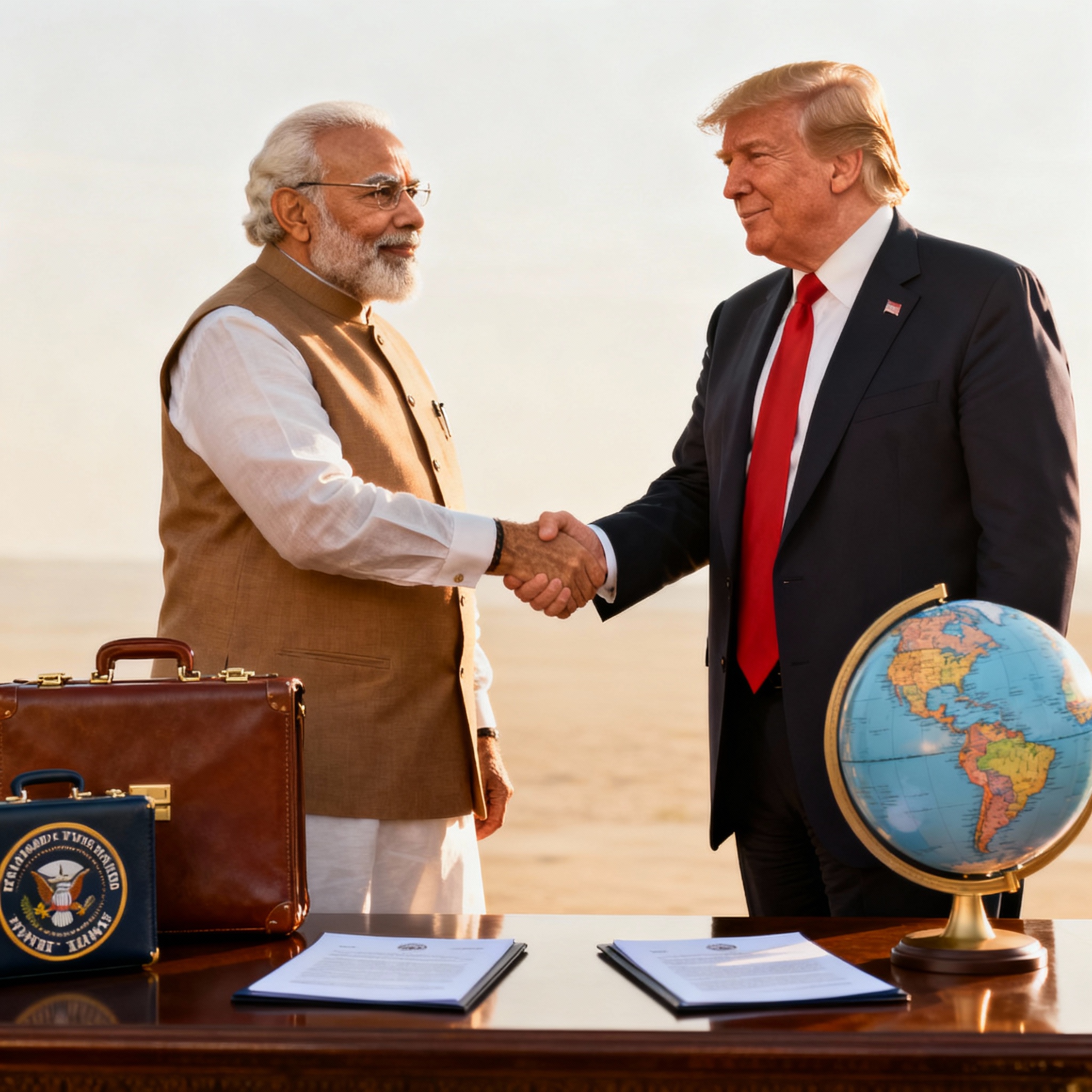
CONTEXT: President Trump announced the resumption of trade talks with India. PM Modi welcomed the move, and both leaders will speak in the coming weeks to push forward the Free Trade Agreement (FTA), targeted for conclusion by fall 2025.
What is an FTA?
- A Free Trade Agreement (FTA) is a pact between two or more countries to reduce or eliminate trade barriers such as tariffs, quotas, and import duties, aiming to increase market access and economic cooperation.
Why Did Relations Strain?
- High U.S. Tariffs: 50% tariffs imposed on India for buying Russian oil.
- Russian Oil Dispute: U.S. demanded India halt Russian oil imports, seen as funding Russia’s war.
- Ceasefire Misunderstanding: Trump’s claim of mediating India-Pakistan ceasefire angered India.
- Trade Barriers: India’s high tariffs and protectionism frustrated U.S. negotiators.
India’s Diplomatic Outreach
- Engaging U.S.: India’s trade negotiator to visit U.S. to resume talks.
- Balancing Relations: Modi’s visits to China and Russia show strategic autonomy.
- Defending Sovereignty: India rejects U.S. pressure on Russian oil as unfair.
- Regional Diplomacy: India strengthens ties with China and Russia amid U.S. tensions.
Current Trade Issues
- Tariff Disputes: U.S. 50% tariffs hit Indian exports like textiles and jewelry.
- Agriculture Sticking Point: India resists U.S. demands for farm and dairy market access.
- Russian Oil Imports: India’s 2M bpd Russian oil imports remain a key issue.
- Trade Deficit: U.S. seeks to reduce $45.8B trade deficit with India.
Strategic Angle
- Countering China: U.S.-India partnership aims to balance China’s Indo-Pacific influence.
- Economic Goals: Both target $500B in bilateral trade by 2030.
- Geopolitical Leverage: India’s Russian ties complicate U.S. strategy on Ukraine.
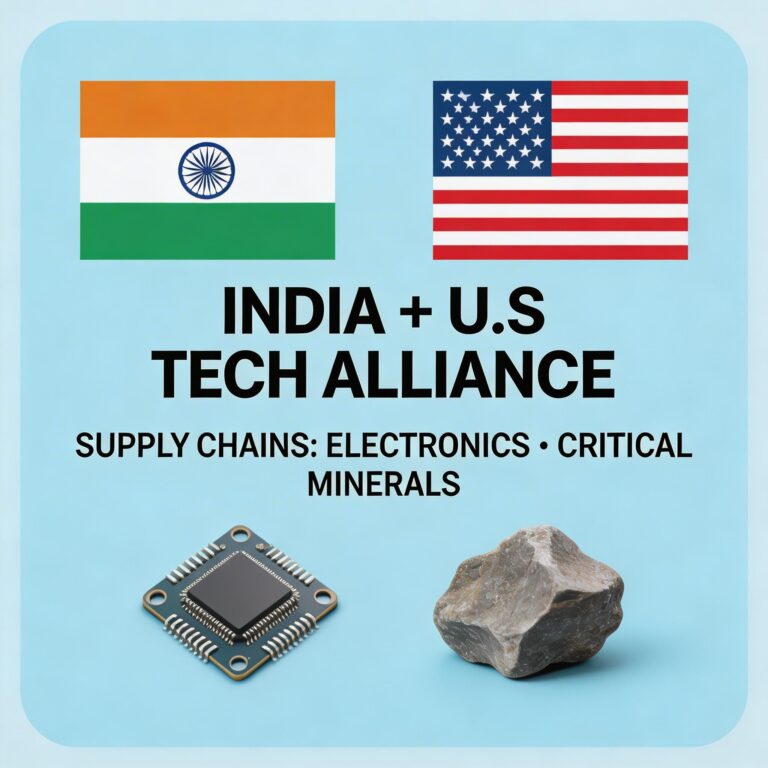
- Global Supply Chains: Tariffs risk disrupting India’s role in global markets.
2. ‘India set to be among top five shipbuilding nations by 2047’
GS Paper II (International Relations) and GS III (Economy, Environment).
Context: The vision was outlined at INMEX SMM India 2025 by the Ministry of Ports, Shipping and Waterways, reaffirming long-term maritime goals.
Background About It.
- India currently ranks 16th globally with 1% of world tonnage, targeting top 10 by 2030 and top 5 by 2047.
- Maritime sector contributes 4% to GDP, with a vision to expand significantly under Maritime India Vision.
Why Shipbuilding Matters?
- Creates large-scale employment and skills.
- Strengthens blue economy and exports.
- Enhances strategic competitiveness globally
Government Measures to Support
- Launched Shipbuilding Finance Assistance Scheme and $3B Maritime Development Fund (45% for shipbuilding, 20% for Indian tonnage).
- Supports ship repair clusters, National Shipbuilding Mission, Shipbreaking Credit Note, and 30% subsidies.
Economic Impact
- Aims to increase maritime share from 4% to 12% of GDP by 2047.
- Elevates India’s global maritime rank from 16th to 5th, boosting trade and employment.
Seafarer Growth
- Indian seafarers hold 12% of global workforce, targeting 25% by 2047.
- Key to expanding shipbuilding and repair industries.
Sustainability Focus
- Emphasizes green shipping initiatives and modernized infrastructure.
- Integrates eco-friendly practices into the National Shipbuilding Mission.
Global Superpower Goal
- Maritime India Vision positions India as a global maritime superpower by 2047.
- Backed by investments in port infrastructure and coastal shipping.
Strategic Angle
- Strengthens India’s maritime self-reliance amid global supply chain disruptions.
- Enhances geopolitical influence through a robust maritime presence.
Conclusion: India’s strategic maritime push, supported by a $3B fund and subsidies, aims to transform it into a global shipbuilding leader by 2047.
3. Why is Kathmandu Burning?
GS Paper 2: IR – India & Its Neighborhood – Relations
Context: On September 8–9, 2025, Nepal faced chaos as Gen Z-led protests turned violent over corruption and a ban on 26 social media platforms, burning PMs’ homes and storming jails.
Generation Z and Rising Discontent
- Drivers of Anger: Frustration over corruption, chronic unemployment, and decades of political stagnation since 2008 fueled this youth-led uprising.
- Digital Spark: The sudden ban on social media platforms such as Facebook, WhatsApp, Instagram, YouTube, and X acted as the immediate trigger, cutting youth off from their main form of communication and solidarity.
- Symbolic Protests: The privileged lifestyles of politicians’ children — derisively termed “Nepo Kids” — became a key target of generational resentment.
- Demands: While reinstatement of social media was achieved early on, protestors posed broader demands for accountability, jobs, and systemic change.
From Protest to Violence
- State Crackdown: Security forces opened fire, killing 19 young demonstrators, which further inflamed the unrest.
- Assault on Leaders: The homes of five former Prime Ministers — Oli, Prachanda, Madhav Kumar Nepal, Jhala Nath Khanal, and Sher Bahadur Deuba — were torched. Jhala Nath Khanal’s wife, Rajyalaxmi Chitrakar, died of burn injuries, while Deuba and his wife, Foreign Minister Arzu Deuba, were physically assaulted.
- Shocking Incidents: Protesters stormed Nakkhu Jail and freed Rabi Lamichhane, a popular critic of Oli, after setting the prison on fire.
- Political Humiliation: Finance Minister Bishnu Prasad Paudel and MP Eknath Dhakal were stripped and paraded, symbolizing public vengeance against the elite.
Leadership Vacuum and Constitutional Crisis
- Collapse of Authority: Oli stepped down as Prime Minister, and President Poudel went into hiding.
- Army’s Position: General Ashok Raj Sigdel, Army Chief, appealed for calm and took control of security but notably refrained from seizing political power.
- Future Path: An interim government led by emerging figures such as Kathmandu Mayor Balen Shah, a popular Gen Z icon, is being discussed.
- Constitutional Challenge: Dissolution of Parliament and even a collapse of the 2015 Constitution are now being openly debated.
Expanding Role of the Nepal Army
- Security First: The Army has assumed responsibility for maintaining law and order across the capital.
- Political Caution: In contrast to past coups, it appears reluctant to directly grab power.
- Mediator Role: Instead, the Army is likely to act as a facilitator between leaders and protesters, aiming to de-escalate the crisis while avoiding bloodshed.
Opposition in Disarray, New Leaders Emerging
- Youth Rage Across Spectrum: The revolt targeted all established leaders, regardless of party.
- New Leadership: Balen Shah, the outspoken mayor of Kathmandu and former rapper, along with Rabi Lamichhane of the RSP, have emerged as popular youth-backed alternatives.
- Monarchical Undertone: Former King Gyanendra Shah offered condolences to victims and called for dialogue, subtly signaling readiness to reclaim relevance in a fractured polity.
India’s Strategic Calculations
- Regional Concern: India views the turmoil with deep unease, given its open border, large Nepali diaspora, and intertwined economic and security interests.
- Difficult Balancing: India continues to face suspicion of partisanship due to its earlier role in backing Maoists and republicanism in 2008.
- Official Stance: Prime Minister Narendra Modi chaired a Cabinet Committee on Security meeting, underscoring that peace, stability, and prosperity in Nepal remain essential for India’s strategic well-being.
Conclusion: Nepal’s Gen Z uprising marks a watershed moment in its political trajectory — the clearest collapse of public trust in traditional elites. Fueled by corruption, unemployment, and digital suppression, the revolt has forced a generational realignment that could redefine Nepal’s institutions. For India, the crisis presents both risks and openings: an opportunity to rebuild goodwill through calibrated diplomacy, but also a warning against repeating past missteps. The coming weeks will decide whether Nepal finds stability through dialogue and reform or plunges deeper into prolonged turbulence.
4. The way forward on Katchatheevu, Palk Strait disputes
GS-I (Geography) or GS-III (Environment and Economy)
Context: During PM Narendra Modi’s April 2025 visit to Colombo, India and Sri Lanka revisited old disputes on Katchatheevu island and the fisheries crisis in the Palk Straits.
- Modi stressed a “humane approach” balancing fishermen’s livelihoods with marine conservation.
Livelihood and Conservation at Odds
- Tamil Nadu and Northern Sri Lanka fishers have shared Palk Straits for centuries.
- Main conflict arises from Indian mechanised bottom trawlers crossing Sri Lankan waters.
- Bottom trawling banned in Sri Lanka (2017) for destroying coral, shrimp beds, and fish stocks.
- Tamil Nadu’s artisanal fishers also lose out, pushed into contested waters.
- Conflict is partly within Tamil fishers: trawler operators vs traditional subsistence fishers.
Clearing the Misconceptions on Katchatheevu
- Katchatheevu is tiny, uninhabited, except for St. Anthony’s church.
- India–Sri Lanka 1974 Maritime Boundary Treaty gave it to Sri Lanka.
- Treaties are binding under pacta sunt servanda; cannot be revoked unilaterally.
- Myth of “Indira Gandhi gifting the island” is misleading.
- Records showed Sri Lanka’s stronger historic administrative control.
- Global precedents (e.g., ICJ Minquiers case, Rann of Kutch arbitration) affirm sovereignty based on jurisdiction.
- Thus, Katchatheevu’s sovereignty is settled in law, though fishing rights remain separate.
Legal & Cooperative Framework
- Palk Bay & Gulf of Mannar = “historic waters”; no innocent passage without explicit consent.
- Judicial backing: Madras HC in Annakumaru Pillai case (1904) upheld traditional fishing rights.
- UNCLOS Article 123: mandates cooperation in semi-enclosed seas.
- Global model: Baltic Sea Fisheries Convention → shared quotas.
- Possible frameworks:
- Equitable quota of fishing days/catch.
- Joint research station on Katchatheevu.
- Promote deep-sea fishing in India’s EEZ (200 nautical miles).
Toward Good Neighbourhood Policy
- India-Sri Lanka share deep cultural ties, needing cooperative solutions.
- Prioritize artisanal fishers’ livelihoods and sustainable practices.
- Respect 1974 Treaty to avoid rhetoric and ensure regional stability.
- Levels of engagement:
- Govt-to-Govt talks upholding treaties.
- State/Provincial dialogue: Tamil Nadu–Northern Province involvement.
- People-to-people empathy to counter distorted media narratives.
Conclusion: The fisheries issue is about balancing livelihoods and sustainability, not sovereignty.Katchatheevu’s status is legally settled; the real focus must be resource management.Cooperative frameworks, deep-sea alternatives, and treaty respect can turn confrontation into cooperation.In the long run, minor disputes should not derail the larger vision of peace, prosperity, and mutual respect in South Asia.
5. A joint and new journey along the SCO pathway
General Studies Paper II: International Relations
Context: The Shanghai Cooperation Organisation (SCO) Summit was held in Tianjin, China, with PM Narendra Modi in attendance.
- The summit coincided with the 75th anniversary of China–India diplomatic ties, with both sides calling for stronger cooperation despite unsettled disputes.
A Summit of Solidarity and Friendship
- SCO has become the world’s largest regional organisation since its creation 24 years ago.
- Tianjin Summit was the largest ever, attended by leaders of 23 countries and 10 global organisations.
- Aim: renew friendship, explore cooperation, and push SCO into a stage of “high‑quality development”.
Significance of the SCO Tianjin Summit
- Largest SCO summit since inception; attended by 23 nations and 10 international organisations.
Key outcomes:
- Tianjin Declaration and creation of four new security centres (including Anti-drug Center, Universal Counter-terrorism Centre).
- Proposal for an SCO Development Bank.
- Adoption of a 10-year development strategy.
- Launch of China-SCO platforms in energy, green industry, and digital economy plus centres for science, higher education, and vocational training.
China’s Global Governance Push
- President Xi announced the Global Governance Initiative: principles of sovereign equality, international rule of law, multilateralism, people-centred development, and action-oriented cooperation.
- China projects SCO as a platform for reforming global governance.
Role of India at SCO
- India joined SCO in 2017; contributed to advancing SCO development.
- China acknowledged India’s support for its SCO presidency and sought cooperation in security, financing, digital economy, and energy.
India–China Bilateral Dimension
- 2025 marks 75 years of diplomatic ties (“diamond jubilee”).
- Xi and Modi agreed: “India–China are partners, not rivals.”
- Common understandings:
- Resume dialogue mechanisms to build strategic trust.
- Expand cooperation in trade, investment, education, culture, tourism, poverty alleviation.
- Strengthen people-to-people links, think tank and media exchanges.
- Maintain border peace while not letting boundary disputes define relations.
The Road Ahead
- Consolidate strategic trust: Learn from 75 years, strengthen perceptions of mutual respect, peaceful coexistence, common development; resume dialogue mechanisms.
- Expand exchanges: Focus on development as common ground; boost trade, investment; cooperate in tech, education, culture, tourism, poverty alleviation; promote party, think-tank, media, youth exchanges.
- Enhance good-neighborliness: Uphold Five Principles of Peaceful Coexistence; respect core interests; maintain border peace; avoid letting boundary issue define relations.
- As populous Global South nations, share interests in development, peace, governance; support each other’s BRICS presidencies; implement Global Governance Initiative; oppose hegemony; build shared future community.
6. Digital platform to preserve and promote tribal art, culture launched
General Studies Paper I: Indian Heritage and Culture
Context: The Union Ministry of Tribal Affairs launched the beta version of “Adi Sanskriti”, a digital platform to preserve and promote tribal artforms and heritage.
What is Adi Sanskriti?
- Envisioned as the world’s first Digital University dedicated to tribal art, culture, and knowledge.
- Aims to safeguard tribal heritage and empower tribal communities by connecting them with global audiences.
Key Components
- Adi Vishwavidyalaya (Digital Tribal Art Academy): Offers online courses on tribal dance, crafts, music, folklore, etc.
- Adi Sampada (Socio-Cultural Repository):A digital archive with over 5,000 curated documents about tribal paintings, textiles, artifacts, and livelihoods.
- Adi Haat (Online Marketplace): An e-market platform to sell crafts and products made by tribal artisans directly to consumers.
Development and Collaboration
- Developed in partnership with State Tribal Research Institutes (TRIs) from 15 states for authentic cultural representation.
- Launched at Bharat Mandapam, New Delhi during the National Conference on Adi Karmayogi Abhiyan.
Long-Term Vision
- To expand into a full-fledged Tribal Digital University offering certifications, advanced research, and academic programs.
- To become a global center for tribal knowledge, promoting digital education, cultural preservation, and sustainable livelihoods.
Significance
- Bridges tradition and technology for preservation, education, and livelihood creation.
- Helps tribal communities thrive in the digital economy while protecting their cultural identity.
- Part of the government’s vision for an inclusive and developed India by 2047.
7. ISRO inks agreement with HAL for transfer of SSLV technology
General Studies Paper III: Science and Technology
Why in News?
- ISRO signed a technology transfer agreement with Hindustan Aeronautics Ltd. (HAL) for the production of Small Satellite Launch Vehicles (SSLV).
- This is the 100th tech transfer deal facilitated by IN‑SPACe, marking increased industry involvement in India’s space sector.
What is SSLV?
- Small Satellite Launch Vehicle (SSLV) is a compact, cost-effective rocket designed to launch small satellites (payloads up to ~500 kg) into low earth orbit.
- SSLV offers faster turnaround and is tailored for frequent, flexible, and affordable satellite launches.
Significance of the Agreement
- Marks a major step in involving Indian industry (HAL) in space manufacturing and launch capabilities.
- Enables HAL to independently build and commercialise SSLVs for domestic and international satellite markets.
- Promotes cost-competitive, regular satellite launch services, boosting India’s position in global small-satellite launch demand.
- Strengthens the ecosystem of public-private partnerships in space, advancing India’s space sector commercialization.
Institutional Players Involved
- ISRO (Indian Space Research Organisation): Provides technology, training, and technical support.
- HAL (Hindustan Aeronautics Ltd.): The industry partner selected to manufacture SSLV technology.
- NSIL (NewSpace India Limited): Government’s commercial arm for space sector marketing and services.
- IN-SPACe (Indian National Space Promotion and Authorisation Centre): Regulator and promoter facilitating technology transfers and industry participation.
Additional Details
- The technology transfer process will be completed within 24 months from signing the agreement.
- HAL will receive hands-on training and technical assistance from ISRO during this period.
- HAL outbid a consortium led by Adani Group-backed Alpha Design Technologies.