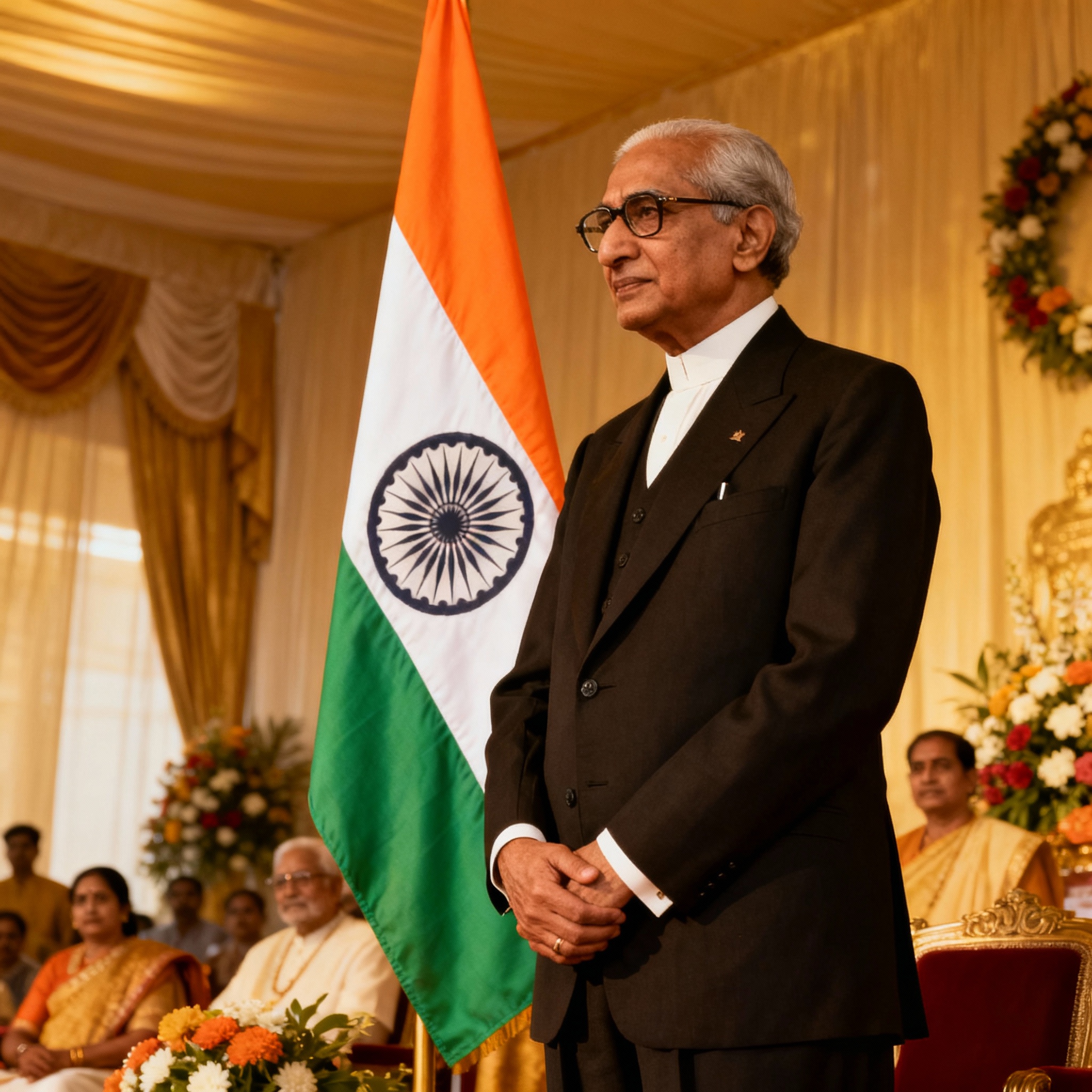
1. Radhakrishnan elected Vice-President of India
General Studies Paper II Indian Polity and Governance, Topic: Union Executive and Parliament (specifically, the Vice-President’s office, election, powers, and functions as ex-officio Chairman of Rajya Sabha).
Context: C.P. Radhakrishnan was elected as India’s 15th Vice President on September 9, 2025, securing 452 first preference votes against his opponent Justice B. Sudershan Reddy’s 300 votes.
- This election became significant as it followed the unexpected resignation of Jagdeep Dhankhar in July 2025 due to health reasons, marking the first early vice-presidential election since 1987.
- The election witnessed a remarkable 98.2% voter turnout with 767 MPs casting their votes out of 781 eligible electors.
- Radhakrishnan’s victory margin of 152 votes exceeded expectations and indicated possible cross-voting from opposition ranks, as the NDA secured 13 more votes than its estimated strength.
Constitutional Status
- The office of the Vice President is established under Articles 63-71 of the Constitution of India, making it the second-highest constitutional office in the country.
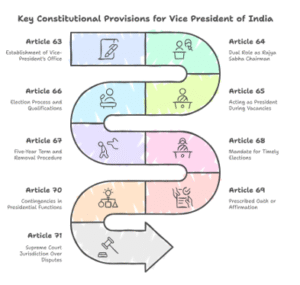
- Article 63 simply states “There shall be a Vice-President of India,” establishing the constitutional foundation for this office.
The Vice President holds a unique dual role in India’s constitutional framework:
- Executive Capacity: As Vice President, the officeholder is part of the Union Executive and acts as President during vacancies under Article 65.
- Legislative Capacity: Under Article 64, the Vice President serves as the ex-officio Chairman of the Rajya Sabha and cannot hold any other office of profit.
- This dual capacity distinguishes India’s Vice President from most other democratic constitutions worldwide, with only the United States having a somewhat similar arrangement.
Role and Functions of Vice President
Primary Constitutional Functions
- Ex-officio Chairman of Rajya Sabha: Under Article 64, the Vice President automatically becomes the Chairman of the Upper House of Parliament, presiding over its sessions and ensuring orderly conduct of business.
- Acting President: According to Article 65, when a vacancy occurs in the President’s office due to death, resignation, or removal, the Vice President acts as President until a new President is elected and assumes office. However, this role is temporary and limited to six months until fresh presidential elections are held.
Powers and Functions as Rajya Sabha Chairman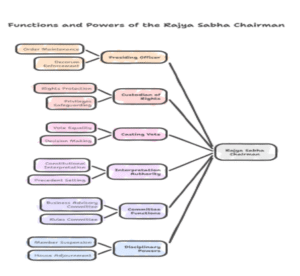
Election Process
Electoral College Composition
The Vice President is elected indirectly by an electoral college consisting of all members of both Houses of Parliament. This includes:
- 233 elected members of Rajya Sabha (currently 5 seats vacant)
- 12 nominated members of Rajya Sabha
- 543 elected members of Lok Sabha (currently 1 seat vacant)
- Total: 788 members (currently 781 due to vacancies)
Key Distinctions from Presidential Elections
The Vice-Presidential electoral college differs from the Presidential electoral college in two important ways:
- Includes nominated members of both Houses (excluded in presidential elections)
- Excludes state legislative assemblies (which participate in presidential elections)
Dr. B.R. Ambedkar explained this distinction, noting that since the Vice President’s primary role is presiding over Rajya Sabha, state legislature involvement was unnecessary.
Voting System
- Proportional Representation: Uses the system of proportional representation by means of single transferable vote.
- Secret Ballot: All voting is conducted by secret ballot, with no party whips applicable.
- Preference Marking: Electors rank candidates by preference using international numerals, Roman numerals, or recognized Indian language numerals. First preference is mandatory for ballot validity.
Nomination Requirements
- Candidates must be nominated by at least 20 MPs as proposers and 20 MPs as seconders
- Security deposit of ₹15,000 required in the Reserve Bank of India
- Maximum of 4 nomination papers per candidate
Timeline and Administration
- Elections must be completed within 60 days of term expiry
- Election Commission of India conducts the election
- Returning Officer (usually Secretary-General of either House by rotation) oversees the process
Constitutional Provisions
Qualifications
Constitutional Requirements (Article 66)
- Citizenship: Must be a citizen of India
- Age: Must have completed 35 years of age
- Rajya Sabha Eligibility: Must be qualified for election as a member of Rajya Sabha
- No Office of Profit: Cannot hold any office of profit under Union Government, State Government, or local authorities
Oath
Constitutional Provision (Article 69)
The Vice President must take an oath or affirmation before assuming office. The prescribed form states:
“I, A.B., do swear in the name of God/solemnly affirm that I will bear true faith and allegiance to the Constitution of India as by law established and that I will faithfully discharge the duty upon which I am about to enter.”
Administration
- Administered by: The President or a person appointed by the President
- Timing: Must be completed before entering office
- Significance: Demonstrates commitment to constitutional values and impartial discharge of duties
Conditions of Office
Restrictions and Prohibitions
- No Other Profit Office: Article 64 explicitly prohibits holding any other office of profit
- Legislative Incompatibility: Cannot be a member of Parliament or state legislatures during tenure
- Functional Limitation: When acting as President, cannot perform Rajya Sabha Chairman duties and loses corresponding salary and allowances
Compensation and Benefits
- During normal Vice-Presidential functions, entitled to salary and allowances as prescribed by Parliament. When acting as President, receives Presidential emoluments but loses Rajya Sabha Chairman benefits.
Term and Vacancy
Normal Term
- Duration: Five years from the date of assuming office under Article 67
- Continuation: Can continue beyond term until successor assumes office
- Reelection: Eligible for unlimited reelection
Vacancy Scenarios
A vacancy can occur through:
- Expiry of five-year term
- Resignation to the President
- Removal through constitutional process
- Death
- Disqualification or voided election
Election Timing for Vacancies
- Term Expiry: Election must be completed before current term expires
- Casual Vacancy: Election held as soon as possible (within six months) after vacancy occurrence
Removal Procedure
- Constitutional Process (Article 67)
- Initiation: Removal resolution can only be moved in Rajya Sabha
- Notice Requirement: 14-day advance notice must be given before moving the resolution
- Rajya Sabha Vote: Resolution must pass by effective majority (majority of all then members)
- Lok Sabha Consent: Resolution must be agreed to by Lok Sabha by simple majority
- Procedural Safeguard: Under Article 92, the Chairman cannot preside when removal resolution is under consideration
Powers and Functions
Legislative Powers
- Presiding Authority: Primary responsibility for conducting Rajya Sabha sessions with authority to maintain order and decorum
- Procedural Control: Interprets constitutional provisions and parliamentary rules, with interpretations becoming binding precedents
- Agenda Setting: Works with Business Advisory Committee to prioritize legislative business and allocate discussion time
- Committee Leadership: Chairs crucial committees including Business Advisory, Rules, and General Purposes Committees, and appoints members to Standing and Parliamentary Committees
Administrative Powers
- Secretariat Control: Rajya Sabha Secretariat functions under Chairman’s control and direction
- Privilege Matters: Approval required for raising privilege breach questions in the House
- Bill Corrections: Authority to correct patent errors in bills passed by Rajya Sabha
Judicial and Quasi-Judicial Functions
- Disqualification Decisions: Tenth Schedule powers to decide member disqualification cases under anti-defection law
- Election Dispute Resolution: Supreme Court jurisdiction under Article 71 for election-related disputes
Emergency and Contingency Powers
- Presidential Functions: Temporarily assumes all Presidential powers during vacancies, including executive, legislative, and emergency powers, but limited to six months maximum
- Constitutional Continuity: Ensures uninterrupted governance during Presidential transitions or temporary incapacity
- The Vice Presidency represents a critical constitutional office that balances legislative leadership with executive backup, ensuring both parliamentary efficiency and governmental continuity in India’s democratic framework.
2. The Langkhun festival
General Studies Paper I -Indian Heritage and Culture, History and Geography of the World and Society, Sub-section: Art and Culture
Context: The Tiwa tribal community has been in recent news for several significant developments:The Langkhun festival celebrated by Tiwa tribesmen in Karbi Anglong district of Assam has drawn attention.
- In 2024, the Assam government expanded the Tiwa Autonomous Council to include 113 additional villages, raising the total to 263 villages across Morigaon, Nagaon, Hojai, and Dhemaji districts. Additionally, in July 2025, the All Tiwa Students’ Union (ATSU) staged protests by blocking National
- Highway 27, demanding the eviction of encroachers from tribal lands and inclusion of the Tiwa Autonomous Council under the Sixth Schedule of the Constitution. The government has also designated 98 schools as Tiwa Medium Lower Primary Schools starting from the 2025-26 academic year to preserve the indigenous language.
Location and Distribution
The Tiwa people (also known as Lalung) are primarily concentrated in northeastern India, particularly in:
Primary States:
- Assam – The majority population resides here, especially in Morigaon district (84.54% of Tiwa population), Nagaon district (62.92% of population), Kamrup, and Karbi Anglong districts
- Meghalaya – Particularly in the Ri-Bhoi district
- Arunachal Pradesh, Manipur, and Nagaland – Smaller populations
The community is distinctively divided into two sub-groups:
- Hill Tiwas reside in the westernmost areas of West Karbi Anglong district (Assam) and northeastern corner of Ri-Bhoi district (Meghalaya), maintaining close ties to forest ecosystems and practicing shifting cultivation.
- Plains Tiwas are predominantly found in Morigaon, Nagaon, and Kamrup districts on the southern bank of the Brahmaputra valley, engaged in settled agriculture.
- According to the 2011 Census, the total Tiwa population stands at approximately 200,915 in Assam alone, with the overall population estimated at 371,000 across all states.
Meaning of Tiwa
The term “Tiwa” literally means “the people who were lifted from below“. While they were historically known as Lalungs in Assamese Buranjis, colonial literature, and the Constitution of India, community members prefer to call themselves Tiwa.
The etymology has multiple interpretations:
- In Karbi language, “Lalung” means “sinking from the water”
- In Ahom language, it means “migration towards the west”
- Some believe “TI” means water and “WA” means superior
- Another interpretation suggests it derives from “ti-phar-wali” meaning “a clan living near water”
Legal Status
The Tiwa community holds Scheduled Tribe (ST) status within the State of Assam under Article 342 of the Indian Constitution. However, their legal recognition varies by state:
- Assam: Recognized as ST since the first Constitution (1950). The Lalungs of autonomous districts Karbi Anglong and Dima Hasao were not initially included but gained ST status in 2002.
- Meghalaya: Tiwas are not recognized as a Scheduled Tribe, creating significant challenges for the community members residing there.
- The Tiwa Autonomous Council was established in 1995 following the Tiwa (Lalung) Agreement signed on April 13, 1995, between the state government and Tiwa community leaders. The council operates under the Lalung (Tiwa) Autonomous Council Act, 1995 , providing maximum autonomy within the constitutional framework.
Currently, the community demands inclusion under the Sixth Schedule of the Constitution, which would grant greater autonomy compared to their current statutory autonomous council status.
Language
Tiwa belongs to the Tibeto-Burman language family within the Sino-Tibetan linguistic group. It is closely related to other northeastern languages including Boro, Dimasa, Kokborok, and Garo.
Language Classification:
- Family: Sino-Tibetan
- Branch: Tibeto-Burman
- Sub-group: Bodo-Garo group
- According to the 2011 census, only 34,800 Tiwas speak the Tiwa language, indicating significant language shift toward Assamese, particularly among Plains Tiwas. The government has recognized this challenge by designating 98 schools as Tiwa Medium Lower Primary Schools from 2025-26 to preserve the indigenous language.
Economic Life
The Tiwa community has historically been a predominantly agrarian society with agriculture serving as their primary economic activity.
Traditional Economic Practices:
- Agriculture: Paddy cultivation forms the core of their economy, with major varieties including Sali, Bao, Boro, and Ahu. The system is primarily consumption-oriented, with minimal surplus sold in markets.
- Cash Crops: Some households cultivate mustard, jute, and sugarcane. Horticultural crops like areca nut, bamboo, and betel leaves serve dual purposes for consumption and commercial sale.
Allied Occupations:
- Animal husbandry: Raising pigs, poultry, and cattle for both consumption and income
- Weaving: Culturally embedded activity among Tiwa women contributing to household income
- Fishery and craft work: Traditional occupations using bamboo and cane
- Traditional rice beer brewing: Additional income source
Economic Challenges: The community faces agricultural distress due to low productivity, lack of modern inputs, irregular monsoons, and heavy dependence on subsistence farming. This has led to widespread land alienation as families struggle with financial distress.
Major Festivals
The Tiwa community celebrates numerous festivals that constitute a significant part of their cultural identity:
Primary Festivals:
- Three Pisu (Bihu): The traditional Bihu celebrations adapted to Tiwa customs.
- Borot Utsav (Borot Kham): A major harvest festival featuring the famous Borot dance, where over 1,500 artists participate in large gatherings.
- Langkhon Phuja: Celebrated in two parts – one in Kati (October-November) and another in Fagun. This festival involves worshipping bamboo over four days between October and December, seeking blessings for good harvest and protection from pests.
- Yangli Phuja: Known as the “Lakshmi Puja” of Tiwa people, celebrated once every five years before paddy sowing to seek divine protection for crops.
- Wanshuwa (Wanshúwa Kham): One of the most important celebrations held once every five to six years between June and August. The ceremony involves grinding wet rice to powder using traditional wooden mortars and pestles, with the flour used to make sacred rice cakes.
- , Sogra Phuja Khel Cháwa Kham, and Kablâ Phûja: Other significant religious observances.
- Jonbeel Mela: An annual fair where the traditional barter system of trade is still practiced.
Cultural Elements: During festivals, Tiwas sing two types of songs:
- Lo Ho La Hai: Songs for name-giving, wedding, and harvesting ceremonies
- Lali Hilali Lai: Songs for marriage ceremonies and festivals
Cultural Significance
- The Tiwa community represents one of the most culturally rich tribal groups in northeastern India, serving as important cultural mediators between plains and hills in central Assam.
- Historical Importance: The Tiwas were associated with the Gobha principality, and their historical role as mediators is enacted annually during the Jonbeel Mela. The community has connections to ancient kingdoms and maintains oral traditions about their migration from eastern Darrang district.
- Cultural Preservation: Their festivals, particularly agricultural celebrations, maintain strong connections to seasonal cycles and natural environments. The community has preserved traditional practices including:
- Ambilineal descent system: Where children can take either mother’s or father’s clan name depending on residence patterns
- Bachelor dormitories (shamadi): Important social institutions in Hill Tiwa society
- Traditional governance: Through the “Loro” (priest-chief) system managing multiple village networks
Contemporary Challenges:
- The community faces identity preservation challenges, particularly in Meghalaya where lack of ST status forces cultural adaptation including adoption of Khasi language and surnames.
- The ongoing struggle for Sixth Schedule inclusion reflects their desire to maintain cultural autonomy while participating in modern democratic processes.
- The Tiwa community’s cultural significance extends beyond their immediate region, representing successful preservation of indigenous traditions while navigating modern challenges of development, education, and political representation.
3. Lessons for India: how Kerala is tackling rapid urbanization
GS Paper II: Urban Governance and Development
Context: The Kerala Urban Policy Commission (KUPC) submitted India’s first state-level comprehensive urban policy report to Chief Minister Pinarayi Vijayan on March 30, 2025.
- This groundbreaking initiative projects that 80% of Kerala’s population will be urban by 2050, making Kerala the only Indian state with a dedicated urban policy.
- The 2,359-page report addresses Kerala’s unique “rurban” landscape challenges, where villages and towns blend seamlessly, creating accelerated urbanisation that outpaces infrastructure development and governance capacity.
What is the KUPC?
- The Kerala Urban Policy Commission was established in December 2023 through a state cabinet resolution to design a 25-year urban roadmap.
- This first-of-its-kind state-level urban commission in India was created to address Kerala’s urbanisation rate, which is significantly higher than the national average.
Key Features:
- Composition: 10 experts and 2 municipal representatives
- Mandate: Develop climate-aware urban ecosystems rather than viewing cities as concrete problems
- Timeline: Submitted final report in March 2025 after comprehensive research
- Uniqueness: First state-level urban commission in India, breaking from centralized national frameworks
Why Was It Needed?
Kerala faced urgent urbanisation challenges by late 2023:
Rapid Urbanisation:
- Kerala’s urbanisation pace exceeded national average significantly
- Projections show over 80% urban population by 2050 – a seismic demographic shift
- Current urban sprawl concentrated in vulnerable midlands between coast and highlands
Climate Crisis Pressures:
- Floods devastated Ernakulam district repeatedly [mentioned in article]
- Landslides shattered hillsides across the state
- Coastal zones under sea-level rise pressure threatening communities [mentioned in article]
- Growing gap between climate crisis frequency and urban planning response
Governance Inadequacy:
- Infrastructure development lagging behind urbanisation speed
- Need for tailored solutions specific to Kerala’s geographical and cultural context
- Break from India’s centralized, project-based urban model required [mentioned in article]
What Were the Recommendations of the Commission?
- The commission conducted 33 deep-dive studies and held 53 district-level stakeholder dialogues involving mayors, NGOs, unions, resident associations, gig workers, and panchayat members [mentioned in article]. The final report structured around 10 thematic pillars includes:
Climate and Risk-Aware Zoning
- Develop risk-informed master plans integrating hazard mapping for landslides, coastal inundation, and flood zones
- Align all spatial plans with climate resilience framework for cohesive risk-sensitive development
- Transform planning from reactive fixes to proactive climate preparedness
Digital Data Observatory
- Establish real-time data nerve center at Kerala Institute of Local Administration (KILA)
- Integrate high-resolution LIDAR, ground penetrating radar, tide/water gauges, satellite and weather data
- Provide every municipality with “living intelligence feed” for informed decision-making
Green Fees and Climate Insurance
- Implement targeted green fees on urban development projects in eco-sensitive zones
- Fund disaster risk reduction initiatives, resilient infrastructure, and emergency response systems
- Establish parametric insurance model with pre-approved payouts for disaster-prone areas
Municipal and Pooled Bonds
- Enable Thiruvananthapuram, Kochi, and Kozhikode to issue municipal bonds [mentioned in article]
- Create pooled bond instruments for smaller towns and municipalities
- Bond subscriptions incorporated into 2024 interim Budget [mentioned in article]
Governance Overhaul
- Replace bureaucratic inertia with city cabinets led by mayors [mentioned in article]
- Form specialist cells for climate, waste, mobility, and law with dedicated municipal cadres
- Launch “Jnanashree” program to recruit and deploy youth tech talent
Place-Based Economic Revival
- Thrissur-Kochi: Develop as FinTech hub
- Thiruvananthapuram-Kollam: Establish as knowledge corridor
- Kozhikode: Brand as “City of Literature”
- Palakkad and Kasaragod: Elevate to smart-industrial zones [mentioned in article]
Commons, Culture, and Care
- Revive wetlands and reactivate waterways for ecological restoration
- Preserve heritage zones maintaining Kerala’s cultural identity
- Establish city health councils catering to migrants, students, and gig workers [mentioned in article]
Why is the Report Unique?
Fusion of Data and Narratives
The KUPC pioneered the integration of local narratives with data systems:
- Fishermen’s coastal recession experiences structured into urban data apparatus
- Youth water conservation drives mapped into municipal dashboards
- Bazaar vendors’ mobility concerns reflected in city briefing templates
- LIDAR maps register tidal health near fishing zones based on community input [mentioned in article]
Distinctive Features
- First state-level commission built for sub-national realities, not recycled from national frameworks
- Climate resilience embedded, not appended – every pillar integrates disaster awareness
- Financial emancipation through municipal bonds and green levies giving local bodies fiscal agency
- Dynamic governance transformation from passive bureaucracies to election-led city cabinets
- 360-degree urban system dismantling planning, finance, and governance silos [mentioned in article]
Does It Offer Lessons for Other States?
Kerala’s Urban Commission provides a replicable template with tangible takeaways:
Institutional Framework
- Mandate time-bound commissions with clear deliverables and deadlines
- Combine technical data with lived experience for comprehensive policy development
- Create dialogic systems where citizen inputs map into data observatories
Financial Empowerment
- Empower local bodies with green levies, bonds, and risk premiums
- Develop climate finance advisory cells to access international funding
- Establish parametric insurance frameworks for disaster-prone areas
Governance Innovation
- Insert youth and specialists in governance structures
- Replace bureaucratic inertia with dynamic, election-led city management
- Create specialist municipal cadres for climate, technology, and urban planning
What Next?
The KUPC represents more than urban planning – it “rewired the DNA” of how a state conceives its cities and towns [mentioned in article]. The commission integrated:
- Climate awareness as fundamental planning principle
- Community narratives as data sources for policy development
- Financial empowerment through innovative municipal financing
- Digital governance with real-time data integration
- Identity economy preserving cultural heritage while promoting growth
Implementation Timeline
- Cabinet deliberations expected completion by May 2025
- Two recommendations already accepted from December 2024 interim report
- Metropolitan Planning Committees establishment in Thiruvananthapuram, Kochi, and Kozhikode
- Municipal bonds framework incorporated into recent state budget
Broader Impact
- For Kerala: Opportunity to grow “not just richer, but wiser; not just bigger, but better; not just more urban, but more human.
- For India: Call to action demonstrating that urban transformation isn’t a problem to solve but “a story to be authored – together”, providing a blueprint for other states facing similar urbanisation pressures
The KUPC establishes Kerala as a pioneer in people-centered, sustainable urban development, offering a model that balances economic growth with environmental resilience and social inclusion.
4. Why was Indonesia rocked by protests?
General Studies Paper II – International Relations
Context: Major protests erupted in Indonesia beginning August 25, 2025, after public outrage over high parliamentary housing allowances and ongoing economic austerity.
- Protests became violent on August 28 when Afan Kurniawan, a 21-year-old delivery worker, was killed by a police vehicle, sparking nationwide unrest and international attention.
Background
|
What Happened?
- Protests broadened to demand reversal of MP allowances, justice for Afan’s death, police accountability, and anti-corruption reforms.
- Violence intensified as protesters clashed with police and military, torched government buildings, and targeted politicians’ homes.
- Death toll: At least seven were reported killed, hundreds injured, and over 3,000 arrested or detained.
- Human rights concerns: Rights groups say at least 20 people are missing; allegations of excessive police violence and arbitrary detentions persist.
How Has the Government Responded?
- President Prabowo announced reductions in parliamentary allowances and foreign trips following consensus in Parliament.
- Promised a thorough investigation into Afan’s death and accountability for those involved.
- Warned that riots and looting would be treated as “terrorism and treason”; ordered strong police/military response.
- Fired the officer involved in Afan’s killing; reshuffled the Cabinet, dismissing five ministers including the Finance Minister.
- Opened dialogue with student unions demanding release of demonstrators and detainees.
- Economic concerns: Fitch Ratings warned the unrest could harm Indonesia’s credit profile.
What About Income Inequality?
- Indonesia ranks high in global wealth inequality; the four richest Indonesians possess more combined wealth than 100 of the poorest.
- Issues cited include low wages, job insecurity, expensive education, and shrinking middle class.
- Budget cuts have reduced public works (−70%), economic affairs (−52%), investment (−40%), and education (−25%), leading to tax hikes and student protests.
Is This the First Time Protests Have Emerged?
- Since President Prabowo took office in October 2024, his cost-cutting drive has repeatedly triggered protests, especially over education and taxes.
- The “Dark Indonesia” student movement peaked in February 2025, protesting budget cuts and reduced scholarships, before broader unrest in August.
What Next?
- One police officer fired, five ministers removed, cabinet reshuffled, and MP perks reduced.
- Government has begun talks with protest groups; stability remains uncertain as tensions persist.
- Economic fallout includes property damage, market disruption, and concerns about investment.
Conclusion
Indonesia’s protests reflect deep-rooted frustration over political privilege, economic inequality, and government austerity. The killing of a delivery worker amplified anger at state violence and corruption, turning isolated protests into a national movement. The government has made concessions, but persistent grievances mean further unrest and reform could follow.
5. NARI 2025 REPORT
General Studies Paper I – Indian Society,Topic: Role of women and women’s organizations; population and associated issues; urbanization, their problems and remedies.
Context: The NARI 2025 report was released by the National Commission for Women (NCW) in August 2025 highlighting ongoing safety challenges for women in India’s cities.
- Delhi ranked 28th out of 31 major cities, among the worst-performing, indicating serious gaps in women’s safety even 13 years after the 2012 Delhi bus gang rape.
- The survey covered 12,770 women across 31 cities to assess women’s safety perceptions and experiences.
What is NARI 2025?
- First-ever National Annual Report & Index on Women’s Safety (NARI) in India.
- Joint initiative by NCW, Pvalue Analytics, The NorthCap University, and Jindal Global Law School.
- Measures women’s safety beyond just crime statistics, incorporating perceptions, experiences, infrastructure, and institutional responses.
- Covers overall safety, infrastructure quality, harassment occurrence, domain-specific safety (neighbourhoods, transport, work, education, health, online), and trust in authorities.
Key Findings of NARI 2025
- The national safety score is 65%, with cities categorized as “much above,” “above,” “below,” or “much below” this benchmark.
- Delhi ranked 28th with women reporting high insecurity, especially in deserted and poorly lit areas.
- 31% of women in Delhi said women-friendly infrastructure was minimal or non-existent.
- Harassment in public spaces was higher than the national average: 12% in Delhi vs 7% nationally.
- Frequent harassment was reported by 61% of women in Delhi who faced it more than twice.
Safety Score & Safest Cities
- National safety score: 65%.
- Safest cities: Kohima, Visakhapatnam, Bhubaneswar, Aizawl, Gangtok, Itanagar, Mumbai.
- These cities share characteristics like strong gender equity, inclusive governance, good infrastructure, and effective policing.
Least Safe Places
- Cities ranking lowest included: Delhi (28th), Kolkata, Srinagar, Ranchi, Faridabad, Patna, Jaipur.
- Common issues: weak infrastructure, patriarchal social norms, poor police responsiveness.
Women’s Perception of Safety
- 41% women in Delhi feel unsafe in deserted spaces; 35% feel unsafe after dark.
- In contrast, only 8% felt unsafe during the day.
- 51% demanded more visible policing, with 17% emphasizing timely and proper police action.
- Harassment occurred mostly in neighbourhoods (34%) and transport (32%), proving proximity to home does not ensure safety.
Forms of Harassment
- Most common was verbal abuse (around 58%), followed by physical and digital harassment.
- Repeated harassment highlighted systemic lapses in deterring offenders.
Institutional Gaps
- Women’s limited trust in police and institutions due to slow or inadequate response to harassment complaints.
- Lack of women-friendly infrastructure and safe public spaces.
- Neglected needs of vulnerable groups including migrants, students, gig workers.
Significance of the Report
- NARI 2025 blends hard data with women’s lived experiences, uncovering underreported harassment.
- The report urges policymakers to focus on public infrastructure, change mindsets, and improve institutional response.
- It is a benchmark for measuring women’s safety annually and guides targeted urban safety reforms.
- Highlights that women’s safety is fundamental to education, health, work, and freedom of movement — essential for India’s development.
Conclusion: Despite progress since 2012, the NARI 2025 report reveals significant safety challenges for urban women, especially in Delhi, where poor infrastructure, higher harassment, and weak law enforcement persist. The report calls for urgent reforms in policing, urban planning, and cultural attitudes to ensure women can live, work, and travel safely, making women’s safety a non-negotiable pillar of a developed India.
6. Tariff-hit diamond, jewellery exporters look to West Asia
General Studies Paper III– Economy, Topic: Indian Economy—issues relating to planning, mobilization of resources, growth, development and employment; inclusive growth and issues arising out of it; liberalization, infrastructure
Context: Indian diamond and jewellery exporters are shifting focus to the West Asia market in response to U.S. tariffs on Indian exports [Source: The Hindu].
- The first major step is Saudi Arabia Jewellery Exposition (SAJEX) 2025, a dedicated B2B jewellery show from September 11-13 at the Jeddah Superdome.
- Over 100 exhibitors with 200+ booths will showcase products to 2,000+ buyers from Saudi Arabia, UAE, Hong Kong, and Lebanon.
BACKGROUND
|
The Strategic Shift
- Exporters are eyeing Saudi Arabia’s booming jewellery market, projected to grow from $4.56 billion in 2024 to $8.34 billion by 2030 driven by a young, high-spending population.
- Saudi Arabia is recognized as a business-friendly new hub with growing per capita income, making it a promising new market [Source: The Hindu].
- The shift is also a precautionary measure to diversify markets amid uncertain U.S. tariff policies.
About SAJEX 2025
- SAJEX 2025 is the first B2B jewellery exhibition of its kind in Saudi Arabia, organized by the Gem & Jewellery Export Promotion Council (GJEPC) in collaboration with the Indian Consulate in Jeddah and supported by the Ministry of Commerce & Industry, India.
- The event features over 200 exhibitors across 250+ booths, displaying diamond and coloured gemstone jewellery, 18k-22k gold, platinum, lab-grown diamond jewellery, and bridal collections.
- Attendees include buyers, retailers, wholesalers, and importers from across the Gulf Cooperation Council region and beyond.
- The event includes the Global Jewellery Investment Forum with high-profile discussions on trade, retail, manufacturing, and consumer trends.
Opportunities and Benefits
- SAJEX offers access to the untapped Middle Eastern jewellery market, expanding Indian exporters’ reach beyond traditional markets.
- The exhibition is an opportunity to build new partnerships, strengthen bilateral trade ties between India and Saudi Arabia, and position India as a key jewellery supplier in the region.
- The event also provides a platform for showcasing innovation, craftsmanship, and technology in jewellery design and manufacturing.
Challenges
- Differences in design preferences and aesthetics pose challenges; products designed for the U.S. market may not appeal to Saudi or Gulf buyers [Source: The Hindu].
- Existing competition as local and regional players already cater to Middle Eastern jewellery demand [Source: The Hindu].
- Establishing a foothold requires sustained effort in relationship building, market understanding, and customization.
CONCLUSION: Tariff hits from the U.S. have spurred Indian diamond and jewellery exporters to explore the promising West Asian market through events such as SAJEX 2025 in Jeddah. This strategic pivot aims to tap into the region’s growing luxury consumption driven by youthful and affluent consumers.