
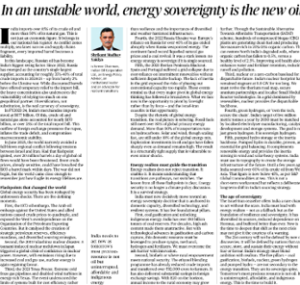
Paper: GS – III, Subject: Economy, Topic: Broad/Overlap, Issue: Steps to ensure energy sovereignty.
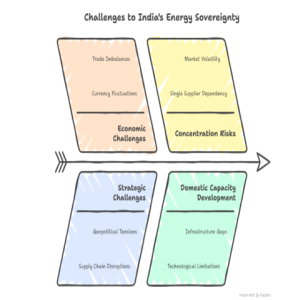
Context : India’s high dependence on imported oil and gas is a major economic and strategic challenge. Since 2022, Russia has emerged as India’s biggest crude supplier, but this concentration creates risks. India’s path to energy sovereignty aims to build resilience and minimize external vulnerabilities.
Energy Sovereignty: A New Priority for India
- Import Dependence :India imports over 85% -90% of its crude oil and more than 50% of its natural gas. to meet its energy needs.
- Vulnerability :high import dependence makes the economy vulnerable to global energy shocks and supply disruptions.
- Economic Impact :Energy imports account for $170 billion, which is about 25% of India’s total import bill.This large import bill weakens the Indian rupee and worsens the trade deficit, impacting economic stability.
- Geopolitical Risks :Russia has become the source of 35–40% of India’s crude oil imports, up from just 2% before 2022. Relying heavily on one country exposes India to strategic and geopolitical risks.
- Global Energy Threats :In June 2025, tensions between Israel and Iran nearly sparked a conflict that could have threatened 20 million barrels a day of global oil supply. Such disruptions have the potential to drive Brent crude oil prices above $103 per barrel very quickly.
- Energy Transition Challenges :Despite global commitments to renewable energy, fossil fuels still supply 80% of the world’s primary energy. Over-reliance on intermittent renewable energy sources can cause problems, as shown by the 2025 blackout in Spain and Portugal when too much conventional power capacity was phased out prematurely.
Lessons from Global Energy Crises
Five major events highlight the need for resilient energy systems:
- 1973 Oil Embargo: Quadrupled oil prices exposed reliance on OPEC, leading to strategic reserves and diversified sourcing.
- 2011 Fukushima Disaster: A nuclear meltdown reduced trust in nuclear power, but rising emissions have renewed its appeal.
- 2021 Texas Freeze: Frozen pipelines and wind turbines showed the need for weather-resilient, diversified infrastructure.
- 2022 Russia-Ukraine War: Europe’s dependence on Russian gas caused price spikes and a coal revival, proving single-source risks.
- 2025 Iberian Blackout: Over-reliance on renewables without backup led to a grid collapse, emphasizing dispatchable energy needs.
Measures for Energy Sovereignty
India’s Five Pillars of Energy Sovereignty
- Coal Gasification:India has over 150 billion tonnes of coal. By advancing coal gasification and related tech, India can produce syngas, hydrogen, and fertilizers domestically, reducing import dependence.
- Biofuels and CBG: Ethanol blending and biofuels have empowered farmers (₹92,000 crore transferred to rural sector) and saved forex. Compressed biogas (CBG) plants also produce cleaner fuels and improve soil health.
- Schemes like SATAT are boosting clean fuel and restoring degraded soils.
- Nuclear Power:India’s nuclear capacity (8.8 GW) has stalled. Expanding nuclear, including thorium and small modular reactors, provides reliable zero-carbon baseload for India’s future grid.
- Green Hydrogen:India aims to produce five million metric tonnes of green hydrogen by 2030. Investing in domestic electrolyser and catalyst tech is crucial for supply chain independence.
- Pumped Hydro Storage:Pumped hydro offers grid stability and inertia alongside renewables like wind and solar. India’s topography is well-suited for such projects.

Energy Realism and the Way Forward
- Fossil Fuels Dominance: Fossil fuels still provide over 80% of global primary energy and 90% of transport energy. Renewables are rising, but remain under 10% of the mix.
- Realism in Transition: India’s energy security must prioritize resilience, diversified sourcing, and domestic innovation. Energy sovereignty means reliable, affordable, indigenous supply for survival.
Conclusion :India’s energy security is a critical national priority due to its high import dependence and exposure to geopolitical risks. The country’s growing reliance on Russian oil highlights the dangers of overconcentration on a single supplier. To build true energy sovereignty, India must continue diversifying its energy sources and develop domestic capacities through coal gasification, biofuels, nuclear energy, green hydrogen, and pumped hydro storage. This strategic approach will help secure affordable, uninterrupted, and indigenous energy supplies — the foundation for India’s resilient and sustainable energy future.
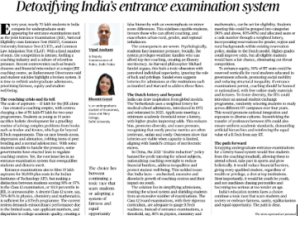
Detoxifying India’s entrance examination system
GS Paper II : Indian society – Health & Education
Context :India’s entrance exams, meant to identify talent for top institutions, have turned into a high-stakes, industry-fueled competition. With coaching fees up to ₹7 lakh, rising student suicides, unequal access, and a false meritocracy, the system takes a heavy economic and human toll. Reforming admissions is now essential.
Background: High Competition and Coaching Industry
Every year, about 7 million students in India compete for undergraduate seats through tough entrance exams like JEE, NEET, CUET, and CLAT. The vast gap between aspirants and available seats has fueled a booming coaching industry charging exorbitant fees of ₹6-7 lakh for two-year programs. Students, sometimes as young as 14, follow grueling routines solving advanced problems far beyond actual course needs, sacrificing holistic development and facing high stress.
Challenges: Broken System and Its Impact
Why Meritocracy in India’s Entrance Exams is Flawed
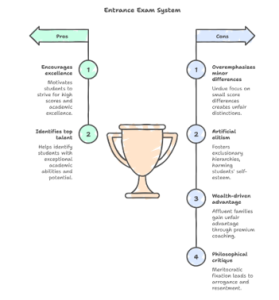
- Overblown Score Differences: Differentiating between 91% and 97% in Class 12 or 99.9 percentile in JEE is arbitrary and unfair.
- Sufficient Academic Threshold: A 70–80% score in physics, chemistry, and math adequately prepares students for B.Tech programs.
- Artificial Elitism: Overvaluing minor score gaps fosters exclusionary hierarchies.
- Wealth-Driven Advantage: Affluent families afford premium coaching, skewing the system toward a false meritocracy.
- Philosophical Critique: Harvard’s Michael Sandel argues against meritocratic fixation, advocating lotteries for fairer elite admissions.
Global Inspirations: Lotteries and Reforms
- The Netherlands uses a weighted lottery system for medical school admissions, where students above a minimum score threshold have chances scaled by grades, promoting fairness and diversity while reducing stress.
- China’s 2021 “double reduction” policy banned for-profit tutoring, nationalizing coaching to control costs, inequality, and student well-being.
Measures : A Fair and Balanced Approach
India can adopt global best practices and simplify admissions:
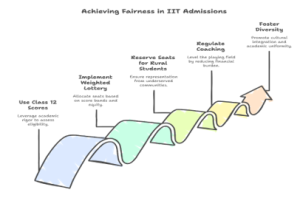
- Use Class 12 Scores :Set a threshold (e.g., 80% in physics, chemistry, and mathematics) for B.Tech eligibility, leveraging the rigorous Class 12 curriculum to replace entrance exams.
- Implement a Weighted Lottery :Group eligible students into score bands (e.g., 90%+, 80%-90%) and allocate seats via a weighted lottery, with higher scores improving chances, as used in the Netherlands’ medical school admissions.
- Include reservations for gender, region, and rural students to promote equity.
- Reserve Seats for Rural Students :Allocate 50% of IIT seats for government school students from rural areas to enhance social mobility and reduce inequality.
- Regulate or Nationalize Coaching :Ban for-profit coaching or provide free online study resources, inspired by China’s 2021 “double reduction” policy, to level the playing field.
- Foster Diversity and Uniformity :Launch an IIT student exchange program to promote cultural integration.
- Encourage professor transfers between IITs to ensure consistent academic quality and reduce campus hierarchies.
Conclusion:
A Call for Fairness and Well-being
Scrapping highly competitive entrance exams in favor of a lottery-based admission would free students from the coaching rat race, allowing them room for holistic growth and reducing financial barriers. It would ensure that admission is not just about affording coaching but also about equal opportunity, sanity, and well-being. India faces a crucial choice — to continue with a toxic, elite-focused system or to embrace fairness, inclusivity, and balanced development for its youth.
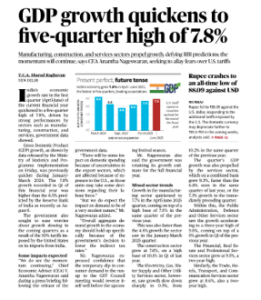
GDP growth quickens to five-quarter high of 7.8% (The Hindu)
Paper: GS – III, Subject: Indian Economy, Topic: Growth and Development, Issue: India’s GDP Growth Surge.
Context :India’s economy demonstrated strong resilience in the April-June quarter of the 2025-26 financial year, achieving a GDP growth rate of 7.8%, the highest in five quarters.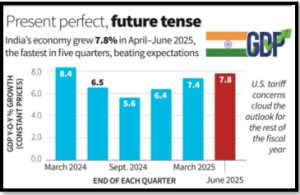
- This robust performance exceeds the Reserve Bank of India’s (RBI) earlier projection of 6.5%, driven by strong activities across manufacturing, construction, and services sectors.
- The growth momentum casts an optimistic outlook despite challenges such as the recent 50% U.S. tariffs on Indian exports and currency depreciation.
Objectives
- Evaluate Economic Performance: Analyze the 7.8% GDP growth and sectoral contributions in Q1 FY25-26.
- Assess External Risks: Examine the impact of U.S. tariffs and rupee depreciation on economic stability.
- Propose Mitigation Strategies: Suggest measures to counter challenges and maintain growth trajectory.
Key Points of India’s Q1 FY25-26 GDP Growth
- GDP Growth Overview: Achieved 7.8% growth, higher than RBI’s 6.5% estimate and the 7.4% in Q4 FY24-25, marking the fastest growth since January-March 2024.
- Real GDP reached ₹47.89 lakh crore, up from ₹44.42 lakh crore in Q1 FY24-25; nominal GDP grew 8.8% to ₹86.05 lakh crore.
- Sectoral Contributions:
- Manufacturing: Grew by 7.7% (vs. 4.8% in Q4 FY24-25, 7.6% in Q1 FY24-25).
- Construction: Recorded 7.6% growth (vs. 10.1% in Q1 FY24-25).
- Services: Expanded by 9.3%, with sub-sectors like public administration (9.8%), financial/real estate (9.5%), and trade/hotels/transport (8.6%) hitting multi-year highs.
- Utilities: Slowed to 0.5% growth (vs. 10.2% in Q1 FY24-25).
- Rupee Depreciation: Fell to ₹88.09 against USD, with forecasts of further decline to ₹89.5-₹90 due to U.S. tariffs.
- Government Stance: Chief Economic Adviser V. Anantha Nageswaran expects modest demand impact from tariffs, with growth sustained by lower indirect taxes and festive season recovery.
- Full-year FY26 growth projection retained at 6.3-6.8%.
Concerns
- U.S. Tariffs: 50% tariffs may reduce GDP growth by 20-90 basis points, impacting export sectors like textiles, gems, and auto parts.Potential export losses of $4-5 billion and up to 2 million job losses.
- Rupee Depreciation: Increases import costs, fueling inflation and raising borrowing costs for companies with foreign debt.Exacerbates capital flight risks and market volatility.
- Sectoral Imbalances: Sharp slowdown in utilities (0.5%) and negative growth in mining (-3.1%) signal uneven economic progress.
- Demand Fluctuations: Temporary dip in consumer demand before the GST Council meeting, with urban consumption remaining weak despite rural resilience.
Challenges
- Export Disruptions: U.S. tariffs threaten export-driven sectors, reducing competitiveness and economic growth.
- Inflationary Pressures: Rupee depreciation and tariff-induced import cost hikes could push inflation beyond RBI’s 2-6% target, with CPI projected at 3.6-4.4% for FY26.
- Uneven Sectoral Growth: Slowdowns in utilities and mining contrast with strong services and manufacturing, risking unbalanced development.
- Fiscal Strain: Fiscal deficit at 29.9% of FY26 target by July-end indicates spending pressures, potentially limiting growth-stimulating investments.
Mitigation Strategies
- Trade Diversification: Expand export markets to Europe, ASEAN, and Africa to reduce reliance on the U.S.Pursue trade agreements, such as ongoing India-U.S. talks, to mitigate tariff impacts.
- Domestic Demand Boost: Leverage lower indirect taxes and proposed GST reforms to stimulate consumption, especially during the festive season.
- Increase rural-focused schemes like MGNREGA to sustain rural demand.
- Rupee Stabilization: RBI to continue interventions in forex markets to curb excessive volatility.Promote export incentives for non-tariff-affected sectors like pharmaceuticals.
- Sectoral Support: Invest in infrastructure and manufacturing to sustain growth in high-performing sectors.
- Address utilities and mining slowdowns through policy incentives and technological upgrades.
- MSME Support: Provide financial aid and export subsidies to micro, small, and medium enterprises hit by tariffs.
Conclusion : India’s Q1 FY25-26 GDP growth of 7.8% signals robust recovery, driven by manufacturing, construction, and services. Despite challenges from U.S. tariffs and rupee depreciation, strong domestic demand and government policies are poised to maintain growth, with disruptions expected to subside before the festive season.
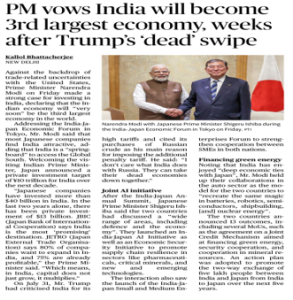
PM vows India will become 3rd largest economy, weeks after Trump’s ‘dead’ swipe
Context: Against the backdrop of trade-related uncertainties with the United States, Prime Minister Narendra Modi made a strong case for investing in India, declaring that the Indian economy will “very soon” be the third largest economyin the world.
Trump had called India’s economy “dead”following a new round of US import tariffs (25%) targeting Indian goods and criticized India’s ties with Russia.
India-Japan Relations: Historical Background
- Diplomatic History: Relations began in 1952, evolving into a strategic partnership with shared democratic values and Indo-Pacific goals.
- Economic Ties: Japan is India’s fifth-largest FDI source, achieving $3.7 trillion of a ¥5 trillion target (2022-26) early.
- Key projects include metro systems, steel plants, and Northeast India development via the Act East Forum.
- Strategic Alignment: Both nations are Quad members, promoting a free and open Indo-Pacific.
- Cultural Exchange: Programs like India-Japan Skill Connect and academic exchanges strengthen ties.
What Drives Modi’s Vow:
- Economic Milestone: India climbed from the 10th largest economy in 2014 to the 5th by 2025, surpassing the UK and on track to overtake Japan and Germany with sustained momentum.
- Dynamic Growth: A 7.8% GDP increase in Q1 FY25-26, the highest in five quarters, outpaces global peers, driven by robust domestic demand, digital progress, a strong services sector, revitalized manufacturing, and consistent infrastructure spending.
- Policy Priorities: The government’s focus on reforms like GST simplification, infrastructure development, FDI attraction, and the “Vocal for Local” campaign enhances resilience against global economic disruptions.
- Global Trade Challenges: Facing rising protectionism and U.S. trade pressures, Modi’s pledge positions India as a self-reliant, adaptable economy ready to thrive in a turbulent global landscape.
- Strategic Messaging: By tying economic ambitions to personal responsibility, Modi galvanizes public and industry support, strengthens investor trust, and reframes external critiques as a unifying call for national progress.
Key Points
- Economic Resilience:
- PM Modi projected India’s rise as the third-largest economy, emphasizing its investment appeal.
- JETRO reports 80% of Japanese firms plan to expand in India, with 75% already profitable.
- Japanese investments in India exceed $40 billion, including $13 billion in the last two years.
- Summit Outcomes:
- Japan committed ¥10 trillion ($67.9 billion) in private investment over the next decade.
Key initiatives:
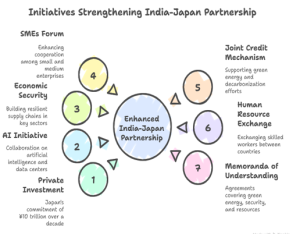
-
- Signed 13 MoUs covering green energy, security, and mineral resources.
- U.S. Tariffs Context:U.S. imposed 50% tariffs on Indian exports, deemed “unreasonable” by India.
- Modi’s Tokyo address counters trade tensions by promoting India’s stability.
Future Prospects
- Economic Growth:Japan’s ¥10 trillion investment will bolster infrastructure, manufacturing, and green energy.Collaboration in AI, semiconductors, and critical minerals to drive technological leadership.
- Global South Role:India as a “springboard” for Japanese businesses to access Africa and the Middle East.
- Sustainability and Innovation:Joint Credit Mechanism to support India’s 500 GW renewable energy goal by 2030 and 100 GW nuclear power by 2047.
- ISRO-JAXA collaboration on Chandrayaan-5 for space advancements.
- People-to-People Ties:Exchange of 50,000 skilled Indian workers to address Japan’s labor shortages.
Challenges
- U.S. Tariffs:May reduce GDP by 0.2-0.9%, impacting $4-5 billion in exports (textiles, gems).Risk of 2 million job losses and wider trade deficits.
- Rupee Depreciation:At ₹88.09, with potential fall to ₹89.5-₹90, increasing import costs and inflation.
- Geopolitical Balancing:Navigating U.S., Russia, and China relations amid trade wars and Quad dynamics.
- Implementation Risks :Ensuring effective execution of MoUs and investment commitments amidst global economic volatility.
Conclusion :
India–Japan relations are evolving beyond economic ties into a comprehensive strategic, technological, and security partnership, with Japan’s massive investment commitments reaffirming India’s role as a growth hub and gateway to the Global South. Despite challenges from U.S. criticism and global protectionism, Japan has emerged as a trusted partner, and the deepening cooperation in areas like supply chain resilience, green energy, and defence will be crucial for India’s march toward becoming the world’s third-largest economy while also strengthening Indo-Pacific stability.
State Energy Efficiency Index (SEEI), 2024
SOURCE : PIB
Why in the News?
- The Bureau of Energy Efficiency (BEE) released the latest State Energy Efficiency Index (SEEI 2024).
About SEEI 2024
- The State Energy Efficiency Index (SEEI) 2024 was released by Shri Akash Tripathi, IAS, Additional Secretary, Ministry of Power and Director General, Bureau of Energy Efficiency (BEE).
- It is developed by BEE, in association with the Alliance for an Energy Efficient Economy (AEEE).
- The index assesses the energy efficiency performance of 36 States and Union Territories (UTs) for the fiscal year 2023-24.
Significance of SEEI 2024
- The index serves as a key policy tool for performance monitoring, benchmarking, and healthy competition among states.
- It guides state-level actions accelerating India’s energy efficiency and climate goals.
- Supports India’s vision of achieving Net Zero Carbon Emissions by 2070 through cost-effective, sector-wise energy efficiency measures.
Framework of Assessment
- Total Indicators: 66 across key sectors
- Buildings
- Industry
- Municipal Services
- Transport
- Agriculture
- DISCOMs
- Cross-sector initiatives
- New focus areas introduced:
- Electric Vehicle (EV) adoption
- Star-rated buildings
- Demand Side Management (DSM)
Classification of States/UTs
- Front Runners: >60%
- Achievers: 50–60%
- Contenders: 30–50%
- Aspirants: <30%
Top Performers : (Based on Energy Consumption Groups)
- Maharashtra: >15 MToE savings potential
- Andhra Pradesh: 5–15 MToE
- Assam: 1–5 MToE
- Tripura: <1 MToE
Sectoral Progress Highlights
- 24 states have notified the Energy Conservation Building Code (ECBC) 2017.
- 10 states have formulated MSME energy efficiency policies.
- 31 states have adopted EV policies promoting electric mobility.
- 13 states are promoting solar-powered agricultural pumps, with Kerala reaching 74% adoption.
- All 36 states and UTs have prepared State Energy Efficiency Action Plans (SEEAPs).
- 31 states/UTs have formed State-Level Steering Committees to support energy transition.
Back2Basics: Bureau of Energy Efficiency (BEE)
Functions include:
Key programs:
|
Prelims Facts

Ice Age-era Dragonfly Rediscovered in the Western GhatS
Context :A 75 million year old, Ice Age-era dragonfly species was recently rediscovered in Alberta’s Dinosaur Provincial Park, New Section 3 Page 7 recently rediscovered in Alberta’s Dinosaur Provincial Park, Canada, marking the first dinosaur-era dragonfly ever found in the country and filling a major gap in the fossil record

About Crocothemis erythraea Dragonfly
- It is a rare species typically found across Europe, Asia, and the Himalayas.
- The species has now been reconfirmed in the high-altitude regions of Kerala and Tamil Nadu in the Western Ghats.
- It closely resembles the more common lowland species Crocothemis servilia, which had caused earlier misidentifications.
- Prefers cooler, elevated habitats above 550 meters, mainly inhabiting montane ecosystems like Sholas and grasslands.
- The species is believed to have migrated to South India during the Ice Age and has survived in these montane refuges ever since.
Significance of the Rediscovery
- Provides insight into how ancient climatic shifts shaped present-day biodiversity patterns.
- Reinforces the Western Ghats as a globally important biodiversity hotspot.
- Highlights the urgent need to conserve sensitive high-altitude habitats such as Sholas and montane grasslands.
- Contributes to ongoing efforts of documenting and preserving India’s rare and unique species.
Scientific Importance and Evolutionary Context:
|
Guru Tegh Bahadur and 350th Martyrdom Day Commemoration
Context: Indian Railways will commemorate the 350th Martyrdom Day of Guru Tegh Bahadur Ji with special trains, cultural programs, and heritage initiatives.

About Guru Tegh Bahadur
- He was the ninth Sikh Guru (1621–1675), revered as Hind Di Chadar (Protector of India).
- Martyred in 1675 in Delhi for resisting the Mughal emperor Aurangzeb’s forced conversions of Hindus to Islam.
- Symbolizes spiritual courage, religious freedom, human rights, and freedom of conscience.
Early Life and Education
- Born on 1 April 1621 in Amritsar, youngest son of Guru Hargobind Ji.
- Trained in martial arts, scriptures, music, and meditation from an early age.
- Participated in battles with his father, instilling values of bravery and selfless service.
- Later lived in Bakala, Punjab, leading a simple life devoted to deep meditation and spiritual teaching.
Key Contributions
Defender of Religious Freedom:
-
- Courageously opposed Mughal policies of forced religious conversions, particularly aiding Kashmiri Pandits.
- Sacrificed his life to uphold the right of individuals to practice their faith freely.
Teachings and Philosophy:
-
- Emphasized spiritual strength over material wealth.
- Advocated compassion, humility, and equality amongst all human beings.
Community Development:
-
- Founded towns including Anandpur Sahib, which later became a major Sikh spiritual and military center.
- Strengthened Sikh institutions and propagated his teachings through hymns included in the Guru Granth Sahib.
Legacy
- Remembered as a champion of human rights and protector of oppressed communities.
- His martyrdom inspired the militarization of the Sikh community under his son Guru Gobind Singh.
- Honored nationwide as a symbol of religious tolerance, justice, and moral courage.
350th Martyrdom Day Commemoration by Indian Railways
- Indian Railways will mark the 350th Martyrdom Day of Guru Tegh Bahadur with special trains, cultural programs, and heritage initiatives to spread awareness among the youth about his teachings and sacrifices.
Initiatives include:
-
- Display of Guru Tegh Bahadur’s Shlokas at railway stations and trains nationwide.
- Running special commemorative trains to different regions during the commemorative period.
- Installation of Punjabi signboards at key railway stations such as in Haryana, Patna, and Hazur Sahib.
- Improved facilities and enhanced cleanliness on pilgrimage trains, including the Sachkhand Express.
- Consideration of renaming Delhi Railway Station as Guru Tegh Bahadur Railway Station.
- Promotion of daily train services to Sikh pilgrimage sites like Takht Sri Patna Sahib, with improved infrastructure.