
G S Paper II -Governance ,Social Justice ,GS paper III -Technology, Economic Development
Context : India’s demographic dividend is called a time bomb because, while the country has one of the youngest populations in the world, gaps in education, skills, and jobs threaten to turn this opportunity into a crisis if not managed wisely.
Historical Context and Background
The concept of demographic dividend emerged in discussions about India’s population in the late 20th century, highlighting how a youthful workforce could boost productivity and GDP, similar to East Asian economies like South Korea.
Rabindranath Tagore’s quote, “Don’t limit a child to your own learning, for she was born in another time,” underscores the core issue: India’s education system is not keeping pace with the rapid changes in the job market, especially due to AI.
What Is the Demographic Dividend?
- India’s working-age population (15-64 years) makes up about 67% of the total, with 800+ million people under 35 years.This large, young workforce could boost economic growth, innovation, and make India a global powerhouse, especially with many countries facing aging populations.
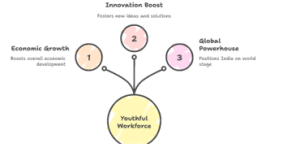
Why Is It a Time Bomb?
Demographic Dividend at Risk
India’s large youth population, often touted as a demographic dividend, is at risk of becoming a liability due to the widening gap between education and real-world skills.
- Underemployment: Many graduates are underemployed or unemployable, including a significant percentage of engineering graduates.
- Skills Mismatch: : Only about 43% of graduates are job-ready; many degrees do not match industry needs.
The Skills Crisis Deepens
The AI revolution is accelerating a skills crisis in India, with McKinsey estimating that nearly 7 out of 10 Indian jobs are at risk from automation by 2030.
- Job Displacement: While AI will create new jobs, a significant number of existing jobs will be displaced, making skilling a national priority.
- Lack of Career Awareness: A Mindler Career Awareness Survey revealed that 93% of Indian students are aware of only seven traditional career options, while the modern economy offers over 20,000 career paths.
- Misaligned Degrees: Over 65% of high school graduates pursue degrees that are not aligned with their interests or abilities, leading to ill-equipped graduates.
Challenges:
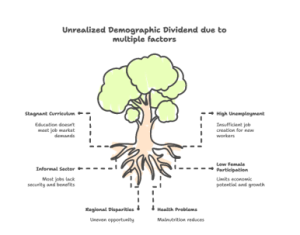
- Slow Curriculum Updates: Education systems are not keeping pace with technology and job market changes.
- Unemployment: Youth unemployment remains high, and job creation is far below the number of new job seekers entering the workforce every year.
- Informal Sector Dominance: Over 90% of jobs are informal, with little job security or benefits.
- Low Female Workforce Participation: Only about 37-42% of Indian women participate in the workforce, constraining economic potential.
- Regional and Social Disparities: Differences across states, rural/urban areas, and gender limit who benefits from opportunities.
- Health Issues: Malnutrition and poor health reduce productivity of the youth population.
Government Initiatives:
- Skill India Mission/PM Kaushal Vikas Yojana (PMKVY): Large-scale skilling programs for youth.
- Startup India, MUDRA Loans: Encouraging entrepreneurship and self-employment.
- National Education Policy (NEP) 2020: Aims to modernize curriculum and focus on skill-based learning.
- Digital India/Ayushman Bharat: Expanding digital literacy and improving healthcare for a healthier, more productive workforce.
- Programs for Women’s Empowerment: Schemes targeting increased female participation and safety at work.
Measures Needed: What More Should Be Done?
- Align education and skilling with the changing needs of the job market, particularly tech and AI skills.
- Promote formalization of jobs for security and benefits.
- Boost women’s workforce participation through skilling, credit, and safer workplaces.
- Targeted investments in health, nutrition, and early childhood development.
- Strengthen career guidance in schools and awareness of a wide range of modern careers.
Conclusion :India’s demographic dividend is a huge opportunity, but unless urgent reforms in education, skilling, employment, and inclusion are made, it risks becoming a destabilizing time bomb—with rising unemployment, social unrest, and wasted human capital. The next decade is critical to shifting from risk to reward.
| Transforming Healthcare for 1.4 Billion Indians |
General Studies Paper II (GS-II), General Studies Paper III (GS-III) –Economic Development:
Context :India’s health-care system stands at a defining juncture. The task is dual: expand access for the millions who are underserved, while ensuring affordability amid rising costs.
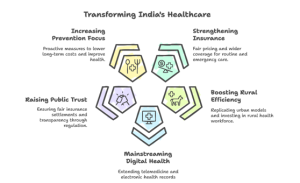
- India’s healthcare system stands at a critical point, shifting from a privilege to a universal right. It must expand access for millions of underserved people while keeping costs affordable. This demands a cohesive approach that strengthens insurance, boosts efficiency, prioritizes prevention, embraces digital health, and builds regulatory trust. By achieving this, India can create an inclusive, sustainable, and globally admired healthcare model.
Insurance: The Foundation of Affordability
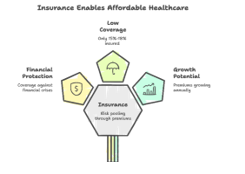
- Risk Pooling: Affordable premiums (₹5,000-₹20,000 for individuals, ₹10,000-₹50,000 for families) provide coverage worth lakhs, protecting against financial crises.
- Low Coverage: Only 15%-18% of Indians are insured; premium-to-GDP ratio is 3.7% (global average: 7%).
- Growth Potential: Premiums hit $15 billion in 2024, expected to grow over 20% annually until 2030.
- Collaboration: Payers, providers, and patients must expand coverage and prioritize prevention, making insurance a daily health tool.
Delivering Quality Care at Scale
- India’s health system is uniquely efficient—an MRI machine handles far more scans daily here than in Western countries without losing quality.
- This efficiency comes from smart doctor-patient ratios, optimized workflows, and infrastructure use developed over decades.
- The next challenge is to bring this efficiency to tier-2 and tier-3 cities, which remain underserved. Doing so can close the access gap and set a global example of inclusive, innovative health care.
Role of Government Schemes
- Ayushman Bharat (PM-JAY): The world’s largest health assurance scheme covers ₹5 lakh per family for nearly 500 million people, delivering cashless treatments in thousands of hospitals and health & wellness centres.
- Ayushman Bharat Digital Mission: Building universal health records and promoting digital continuity of care.
- Expanding insurance: Recent policies aim to double coverage through new programs and include outpatient and diagnostic services in insurance.
- Investment in infrastructure: More medical schools, hospitals, and digital health adoption to close gaps in rural areas.
- Prevention efforts: The government pushes preventive health, including awareness programs for non-communicable diseases and lifestyle improvements.
Prevention: The Most Effective Cost-Saver
- NCD Challenges : families face high expenses for chronic diseases like diabetes and hypertension.
- Redesigning insurance to cover outpatient care and diagnostics and launching a nationwide prevention campaign.
- Public participation is essential—individuals, schools, employers, and communities must promote healthy lifestyles, as preventing illness saves many times the cost of treatment.
Embracing Digital Health and AI
- Pioneering Technology: India led the way in telemedicine and now leverages AI for early sepsis detection, diagnostic triage, and remote consultations.
- Connecting Regions: Urban specialists can support treatment for patients in distant villages, bridging vast geographical gaps.
- Unified Health Records: The Ayushman Bharat Digital Mission promotes nationwide access to universal health records, ensuring seamless care continuity.
Regulation and Trust: Key to Growth
- Rising Costs: Insurers may increase premiums by 10–15% due to health issues caused by pollution.
- Lack of Trust: Households hesitate to adopt insurance without assurance of fair claims and effective grievance resolution.
- Government Action: The Finance Ministry has directed the IRDAI to improve claims processes and enhance consumer protections.
- Investment Imbalance: In 2023, the health sector attracted $5.5 billion in private equity and venture capital, but funds largely focused on metro areas, leaving tier-2 and tier-3 cities underserved.
Key Measures Needed
Conclusion
India can transform health care from a privilege into a right by expanding insurance, prioritizing prevention, scaling up services in all regions, and using digital technology for access and accountability. Systemic reforms, public-private collaboration, and bold investment are essential to create a truly inclusive, sustainable, and affordable health system for every Indian.
| India’s Monsoon Vulnerabilities: A Call for Preventive Strategies |
GS PAPER IIII –Disasater management
CONTEXT : India faces recurring monsoon-related disasters, with heavy rains causing floods and landslides across North India. The 2025 monsoon has been particularly destructive, with concentrated downpours overwhelming fragile Himalayan slopes, flooding plains, and damaging farmland. To break this cycle, India must prioritize preventive measures over reactive relief, focusing on climate-resilient infrastructure, early warning systems, and sustainable land management.
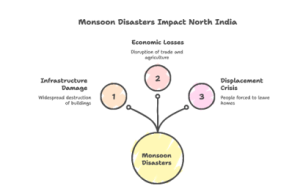
Widespread Damage
- Himachal Pradesh: Districts cut off due to floods and landslides.
- Jammu and Kashmir: Over 40 deaths reported, with swollen rivers breaching flood marks in Srinagar and Anantnag.
- Punjab: Villages and farmland inundated.
- Delhi: Excessive rainfall and a surging Yamuna River caused widespread flooding.
- Cause: Intense, erratic monsoon rains amplify erosion, destabilize slopes, and increase flood risks.
What India Must Prioritize
- India must prioritize preventive measures over reactive relief. This includes building climate-resilient infrastructure tailored to local vulnerabilities, strengthening reliable early-warning systems that reach communities on time, and adopting sustainable land and forest management practices to stabilize slopes and catchments.
The Need for Preventive Strategies
- The consequences of these extreme weather events extend beyond immediate damage. Intense rainfall amplifies local erosion, destabilizes mountain slopes, and increases risks for settlements. Therefore, relief efforts should not be limited to reactive measures. Recognizing the recurring possibility of concentrated, destructive rainfall, it is crucial for both state and central governments to invest in preventive strategies.
- Treating these events as unforeseeable emergencies is a denial of the evidence at hand. Framing each calamity as “unprecedented” distracts from the lessons that should have been learned.
Failures in Himalayan States
- Forest Loss and Development: Unregulated deforestation and road-widening persist in vulnerable areas.
- Unstable Slopes: Absence of slope-safe engineering heightens the risk of landslides.
- Diminishing Catchments: Reduced natural buffers increase slope failures and downstream silt buildup, worsening flood risks.
Gaps in Preparedness
Despite repeated disasters, several gaps in preparedness persist:
- Underdeveloped Early Warning and Evacuation Systems: While the capacity to forecast heavy rain has improved, it is not effectively translated into reliable ground-level warnings.
- Insufficient Community Preparedness: Relief agencies mobilize after the damage has occurred, but systematic drills, pre-positioned supplies, and community preparedness remain inadequate.
- Lack of Climate-Resilient Infrastructure: States and the Centre continue to prioritize strategic road projects and urban expansion, even in unstable landscapes, while climate-resilient infrastructure lags behind.
Environmental Impact
Unsustainable development practices exacerbate the impact of heavy rainfall:
- Deforestation and Road Widening: In Himalayan states, forest clearance and road widening continue without slope-safe engineering in eco-sensitive zones, despite warnings of irreversibly weakened slopes.
- Shrinking Catchment Areas: As catchments’ buffering capacity decreases, the chance of slope failure rises, while silt accumulates in dams and rivers downstream, worsening the flood load.
- Inadequate Compensatory Measures: Compensatory afforestation and rehabilitation rarely match the qualitative attributes of what has been lost, resulting in denuded slopes and populations at higher risk.
Recommendations for a More Resilient Future
To effectively mitigate monsoon vulnerabilities, India must adopt a comprehensive approach that includes:
- Investing in Sustainable Infrastructure: Prioritize climate-resilient infrastructure that can withstand extreme weather events.
- Implementing Landslide Mitigation Measures: Develop and implement strategies to stabilize slopes and reduce the risk of landslides.
- Strengthening Early-Warning Systems: Improve the accuracy and reliability of early-warning systems and ensure that warnings reach vulnerable communities in a timely manner.
- Promoting Community Preparedness: Conduct regular drills, pre-position supplies, and educate communities on how to respond to floods and landslides.
- Adopting Slope-Safe Engineering: Implement slope-safe engineering practices in eco-sensitive zones to minimize the impact of deforestation and road widening.
- Protecting and Restoring Catchment Areas: Implement measures to protect and restore catchment areas to enhance their buffering capacity.
- Prioritizing Climate-Resilient Infrastructure: Focus on developing infrastructure that can withstand extreme weather events, reducing the risk of damage and disruption.
Conclusion : The 2025 North India floods reflect a recurring pattern of climate-driven extremes, not isolated events. Calling each disaster “unprecedented” hinders learning and repeats losses. True resilience requires shifting from reactive relief to prevention through sustainable infrastructure, landslide control, community preparedness, and effective early-warning systems. Without this governance shift toward anticipation, future monsoons will keep causing devastation.
| PM SVANidhi Scheme. 2.0 |
Context :The Union Cabinet, led by Prime Minister Narendra Modi, approved the restructuring and extension of the Prime Minister Street Vendor’s AtmaNirbhar Nidhi (PM SVANidhi) Scheme. The lending period has been extended to March 31, 2030, with a total outlay of ₹7,332 crore. The scheme supports street vendors financially and promotes their socio-economic development.
Background
|
About PM SVANidhi Scheme
- The PM SVANidhi Scheme, launched in 2020 by the Ministry of Housing & Urban Affairs (MoHUA), supports street vendors affected by the COVID-19 pandemic by providing working capital loans to restart businesses and promotes financial inclusion through digital transactions. It offers interest subsidies for timely repayments, cashback incentives on digital payments, and eligibility for higher loan tranches.
- The scheme’s social security component, ‘SVANidhi se Samriddhi,’ provides additional welfare benefits to vendors. As of July 2025, over 96 lakh loans totaling ₹13,797 crore have been disbursed to 68 lakh vendors.
- Under PM SVANidhi 2.0, MoHUA and the Department of Financial Services jointly implement the program with enhanced loan amounts, UPI-linked RuPay credit cards for quick credit access after loan repayment, and expanded coverage to census towns and peri-urban areas. Monthly Lok Kalyan Melas further help vendors access various government schemes. The scheme also emphasizes capacity building in entrepreneurship, digital skills, and food safety, partnering with the Food Safety and Standards Authority of India (FSSAI).
Key Features of the Restructured Scheme
- The Union Cabinet, chaired by Prime Minister Narendra Modi, approved restructuring the PM SVANidhi scheme and extending the lending period from December 31, 2024, to March 31, 2030.
- The total outlay for the extended scheme is ₹7,332 crore.
- The scheme aims to benefit 1.15 crore vendors, including 50 lakh new beneficiaries.
- Enhanced Loan Amounts:
- First tranche increased from ₹10,000 to ₹15,000.
- Second tranche increased from ₹20,000 to ₹25,000.
- Third tranche remains ₹50,000.
- UPI-Linked RuPay Credit Card: For vendors who repay the second loan, providing quick credit access for business and personal needs.
- Digital Adoption Incentives: Cashback up to ₹1,600 on retail and wholesale digital transactions.
- Wider Coverage: Scheme expanded beyond statutory towns to include census towns and peri-urban areas gradually.
- Capacity Building: Focus on entrepreneurship, financial literacy, digital skills, marketing, and hygiene training (in collaboration with FSSAI).
- Holistic Welfare: ‘SVANidhi se Samriddhi’ initiative strengthened via monthly Lok Kalyan Melas to connect vendors and families with government schemes.
Benefits and Achievements
- The scheme promotes inclusive economic growth by providing reliable finance to street vendors, enabling business expansion and sustainable livelihoods.
- Digital empowerment is boosted as vendors actively use digital payments and platforms.
- Received national awards recognizing innovation and digital transformation (Prime Minister’s Award 2023 and Silver Award 2022).
- Supports socio-economic upliftment of vendors and their families, contributing to vibrant, self-sustaining urban ecosystems.
Challenges
- Need to expand reach to all eligible street vendors, including those in peri-urban areas.
- Encouraging complete digital adoption among vendors.
- Building continued capacity and skill development programs.
- Ensuring smooth and timely credit flow through banking channels.
Measures Taken
- Joint implementation by Ministry of Housing & Urban Affairs and Department of Financial Services.
- Introduction of UPI-linked RuPay credit cards for instant credit access.
- Digital cashback incentives to motivate digital payments.
- Monthly Lok Kalyan Melas to connect vendors with government welfare schemes.
- Training programs on entrepreneurship, digital skills, financial literacy, food safety, and hygiene.
Conclusion :The restructured PM SVANidhi Scheme aims to empower 1.15 crore street vendors by providing enhanced financial support, promoting digital transactions, and ensuring holistic socio-economic development. This initiative fosters livelihood growth, financial inclusion, and the transformation of urban economic ecosystems into vibrant, self-sustaining communities.
| Kulasekarapattinam launch complex to handle 20-25 satellite launches annually: ISRO |
General Studies (GS) Paper 3-science and technology
Context :India’s second rocket launch complex, called the Small Satellite Launch Vehicle Complex, is being developed at Kulasekarapattinam in the Thoothukudi district of Tamil Nadu. The foundation stone was laid by Prime Minister Narendra Modi in February 2024, and ISRO Chairman V. Narayanan has announced that it is expected to be ready by December 2026. This spaceport will complement India’s primary spaceport at Sriharikota in Andhra Pradesh.
Strategic Location and Advantages
- The Kulasekarapattinam site is strategically located along the southern coast of Tamil Nadu, close to the equator.
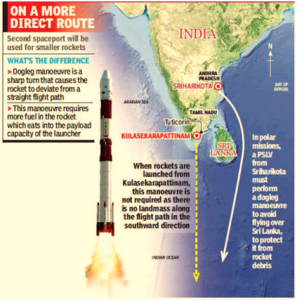
- Its coastal position allows launching rockets directly southwards over the Indian Ocean without crossing other countries’ airspace. This eliminates the need for complex orbital maneuvers required at Sriharikota, where rockets have to avoid flying over Sri Lanka.
- Direct southward launches help save fuel and increase payload capacity for smaller rockets, improving cost-effectiveness and efficiency.
- The near-equatorial location leverages Earth’s rotation for greater boost velocity, further enhancing launch efficiency.
Key Features and Capacity
- The spaceport covers approximately 2,300 acres and will be equipped with about 35 facilities, including launch pads, rocket integration units, ground range stations, and a mobile launch structure.
- It is primarily designed for the Small Satellite Launch Vehicle (SSLV), which can carry payloads up to 500 kg to orbits about 400 km in altitude.
- The facility will handle 20-25 launches annually, focusing mainly on small satellite missions.
- This relieves pressure on the Sriharikota spaceport, which mainly handles larger rockets like PSLVs and GSLVs used for heavier and deep space payloads.
Importance for India’s Space Ecosystem
- The launch complex at Kulasekarapattinam will foster development in India’s growing small satellite and commercial space sectors.
- The Tamil Nadu government is also developing a Space Industrial and Propellants Park near the site, creating a supportive ecosystem for startups, manufacturing, and research.
- By having a dedicated launch facility for SSLVs and smaller rockets, India can increase launch frequency, reduce turnaround time, and enhance global competitiveness in small satellite launches.
- The second spaceport strengthens India’s strategic position in space technology and supports ambitious future missions effectively.
Conclusion :Kulasekarapattinam spaceport provides India with a strategically located, dedicated facility for smaller satellite launches, enabling efficiency, cost savings, and enhanced capacity. It complements the existing Sriharikota spaceport and bolsters India’s space capabilities and commercial space ambitions.
| Birth anniversary of social reformer Ayyankali |
G S Paper I (Indian History and Culture) ,GS Paper II (Governance and Social Justice)
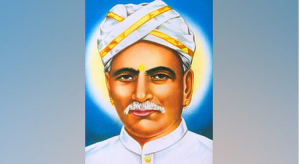
Context :Kerala observed the 162nd birth anniversary of Mahatma Ayyankali (1863–1941), a pioneering social reformer who fought against caste-based oppression and social inequality.
About Mahatma Ayyankali:
- Born: August 28, 1863, in Venganoor, Travancore (now Thiruvananthapuram, Kerala).
- Ayyankali (1863-1941) was a prominent social reformer from Kerala who played a crucial role in fighting caste-based oppression and advocating for the rights of the suppressed Dalit communities in the erstwhile princely state of Travancore.
- Belonging to the Pulayar community, one of the most marginalized castes, he challenged the rigid caste hierarchy and discriminatory practices prevalent in Kerala society during the 19th and early 20th centuries.
Key movements and Contributions
- He founded the Sadhu Jana Paripalana Sangham, an organization focused on education and empowerment of Dalits.
- His efforts led to crucial reforms like allowing Dalit children admission to schools and raising wages for agricultural laborers.
- He was the first Dalit member of the Sree Moolam Popular Assembly, Travancore’s legislative council, symbolizing political representation for oppressed communities.
- Villuvandi (Cart) Journey (1893): Ayyankali defied caste norms by riding a bullock cart through public roads, which were restricted for lower castes, challenging upper-caste dominance and asserting the right to public spaces.
- Kallumala Struggle (1915): He led a protest against the prohibition on Dalit women wearing ornaments or decent clothing, encouraging them to discard stone bead necklaces (kallumala) for dignified attire, symbolizing resistance to caste oppression.
- Education Advocacy: Ayyankali fought for Dalit children’s access to schools, which were previously denied to them, laying the groundwork for educational equity.
Legacy and Importance
- Ayyankali’s tireless struggle laid the foundation for social justice and equality in Kerala, inspiring movements against untouchability and caste-based discrimination.
- His legacy is cherished for pioneering Dalit emancipation and challenging feudal landlordism and caste oppression ahead of his time.
- Kerala’s social progress and achievements in reducing caste inequalities are deeply rooted in Ayyankali’s reformist initiatives.
- His life exemplifies the spirit of resistance for marginalized communities seeking dignity and equal rights, a significant topic in Indian social reform history.
Vaquita Porpoise
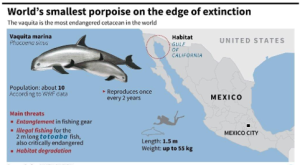
Context :A recent report reveals that only about 10 vaquita porpoises—considered the world’s rarest marine mammal—remain in the Gulf of California (Sea of Cortez), Mexico. Their population has drastically declined mainly due to accidental entanglement in illegal gillnets used to catch totoaba, an endangered fish valued for its swim bladder.
About the Vaquita Porpoise (Phocoena sinus):
- Known in Spanish as the “little cow,” the vaquita is the most endangered marine mammal worldwide. It was first discovered in 1958.
- Porpoises are the smallest members of the cetacean family (which includes whales, dolphins, and porpoises). They are distant relatives of dolphins, having diverged around 15 million years ago.
Habitat:
- The vaquita is found only in the northern part of the Gulf of California, Mexico, predominantly in shallow waters up to 50 meters deep.
Physical Characteristics:
- They have distinctive dark rings around their eyes and dark patches on their lips extending to their fins. Newborns are darker with a gray fringe.
- Their large dorsal fin aids in dissipating body heat in warm water environments.
Behavior:
- Vaquitas are shy and tend to stay close to shore. They avoid boats and typically live either alone or in small groups, unlike other cetaceans that travel in large pods.
Threats:
- The primary threat to vaquitas is bycatch in illegal gillnets used to capture totoaba fish, which is critically endangered.
Protection Status:
- IUCN Red List: Critically Endangered.
- CITES: Appendix I